
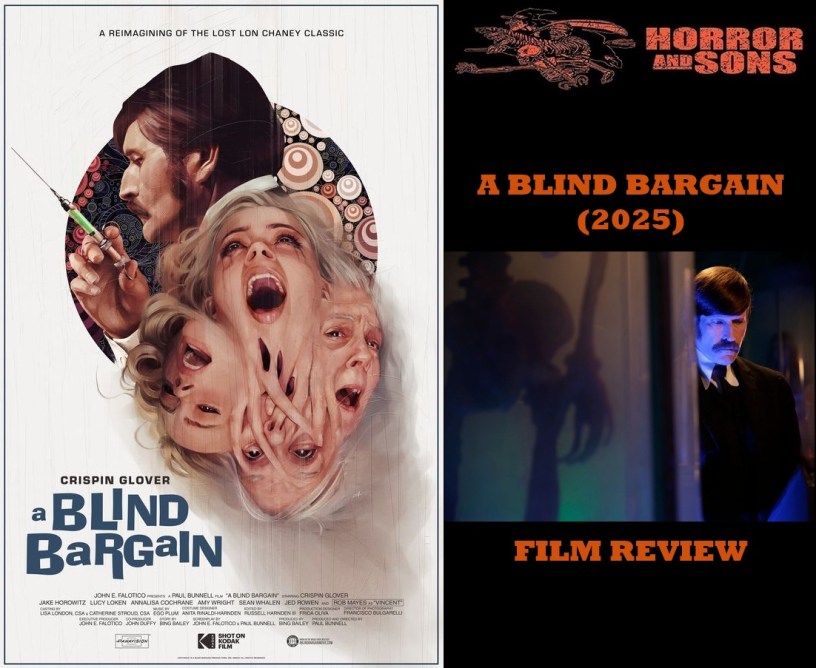
A recently returned Vietnam vet, now drug-addled and deep in debt to his dealer, makes a dubious deal with a morally ambiguous physician in A Blind Bargain, a reimagining of a now-lost 1922 silent horror film of the same name that starred the legendary “Man of a Thousand Faces”, Lon Chaney. This new version of A Blind Bargain was written, directed, and produced by Paul Bunnel (who previously brought us the bizarro 2012 “sci-fi musical” The Ghastly Love of Johnny X) and stars Crispin Glover. Glover, of course, is known to millions as the original “George McFly” in the first Back to the Future film, but will always have a place in horror history for his spasmatic dance moves in Friday the 13th: The Final Chapter. A Blind Bargain hit theaters in New York on April 24th, but expanded to theaters in Los Angeles, Denver, Miami, Houston, Philadelphia, and Washington, DC on May 8th.
Dominic (Jake Horowitz – 2020’s Castle Freak remake, Peacock’s “Devil In Disguise: John Wayne Gacy”) finds himself struggling to adapt to life back home after his stint in ‘Nam. Thanks to the heroin addiction that he developed while overseas, he’s unable to hold a job and now finds himself running dope for a local drug dealer in order to support his habit. However, Dominic’s clearly not very good at this “side job” as he’s now in debt to the man. A Blind Bargain even opens with the dealer, Vincent (Rob Mayes – John Dies at the End, Deep Blue Sea 2), kicking Dominic’s ass over this debt.
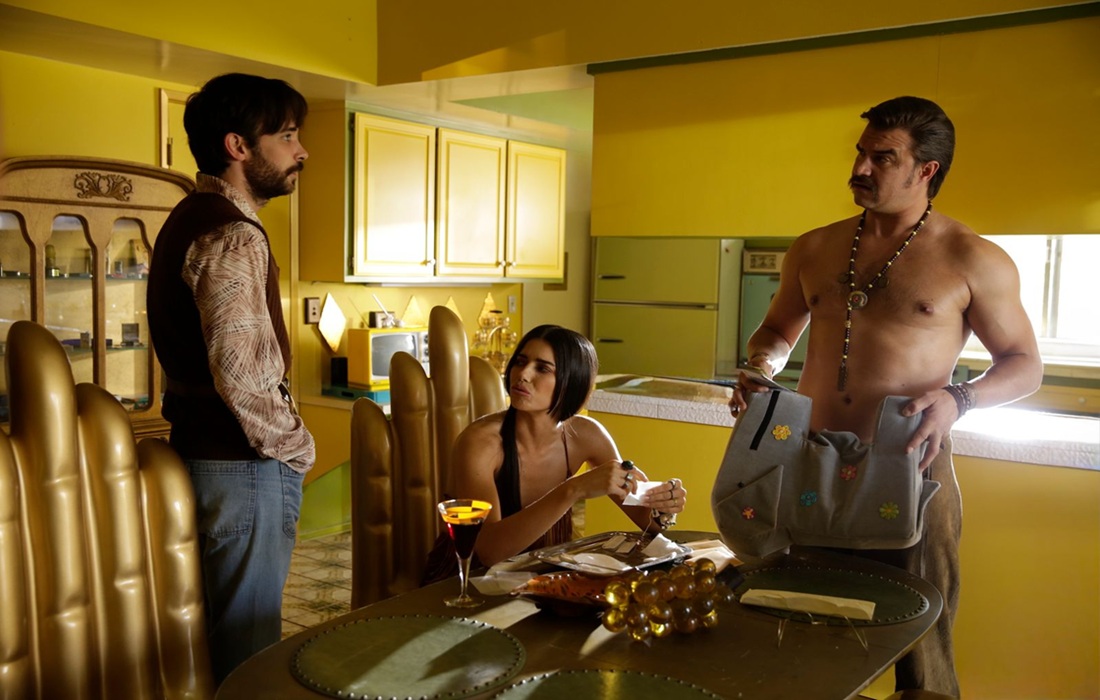
Dominic also finds himself living back at home with his elderly mother, Joy (Amy Wright – The Amityville Horror, Breaking Away), a former star of the silent film era. Adding to his worries is a social worker who has started checking in on his mother’s well-being now that he’s returned home. Even then, it probably comes as little surprise that Dominic often spends his night shooting up in the tub in his mother’s bathroom. Not that I ever encourage heroin use, but Dominic’s drug-induced fantasy is handled quite tastefully; somewhat peaceful and was actually kinda pretty. Well, if you ignore the sounds of gunfire, that is.
Worried not only about her son, but also any troubles that may follow him home, Joy demands that Dominic visit a clinic in order to treat his addiction or else face being asked to leave her house. He does indeed visit a clinic, one owned by a Dr. Gruder (Glover). Here, Dominic is attended to by a young nurse named Ellie (Lucy Loken – “Young Sheldon”, MTV’s “Teen Wolf”), whom he immediately develops an intense attraction to. Of course, it doesn’t hurt matters that Ellie’s own behavior could easily be construed as “flirting”. She checks him over and draws some of his blood for testing, before giving Dominic some methadone and sending him on his way. Junkie that he is, he helps himself to a bottle of Valium before departing.
Soon after, Dominic receives a call from Ellie, who informs him that DNA testing was performed on his blood, which (somehow) determined that his mother’s blood contains a special trait that would be highly beneficial in Gruder’s research. Not that Dominic ever asks what type of “research”, but Gruder spends most of his time and efforts attempting to reverse and/or stop the aging process. Instead, Dominic is far too distracted by the money offered for pints of her blood. Even more tempting is the additional offer to cover the full cost of his rehabilitation. Seeing a pathway out of both debt and addiction, Dominic agrees to Gruder’s deal. He coerces his mother to accompany him to his next appointment as “emotional support”, even going so far as lying by saying that she will be receiving a full spa treatment while she waits.
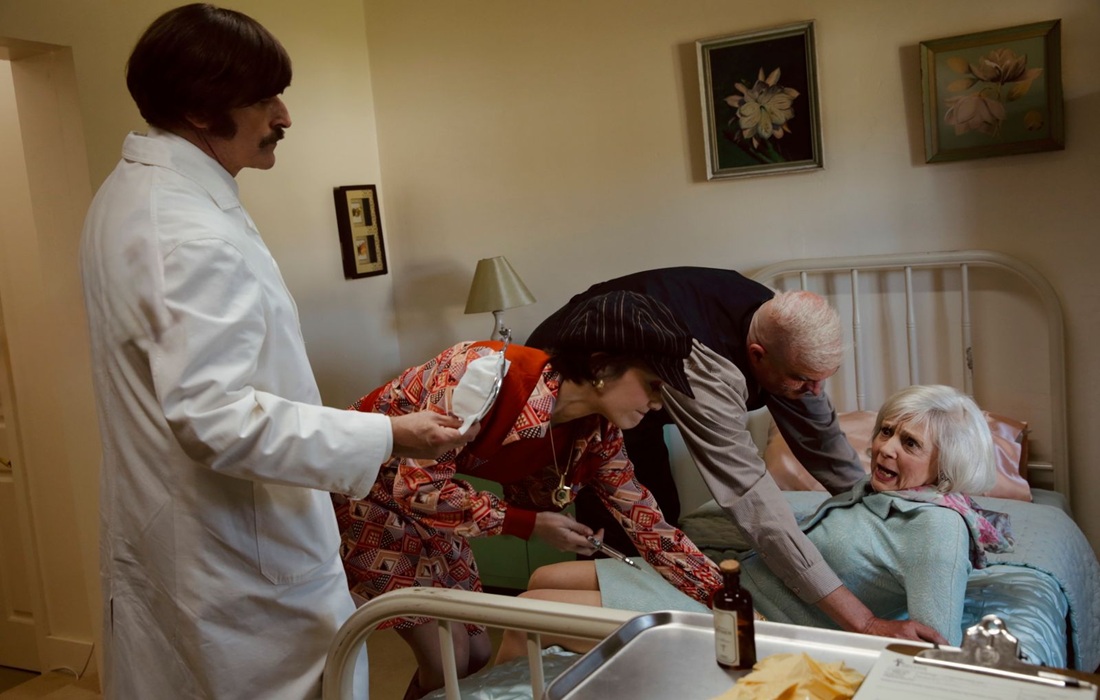
While there is no spa, Joy definitely gets the “treatment” upon reaching Gruder’s office as she is forcibly held down and drugged by the doctor’s assistants. Dominic sheepishly stands back, only able to turn his head as his mother cries for help, only to then sign a document legally releasing the woman to Gruder’s “care”. For his betrayal, Dominic receives a lump some of cash, which he promptly uses to pay off his debt. This said, even Vincent calls Dominic heartless and soulless when he discloses how he obtained the funds.
Naturally, Joy becomes the prime test subject in Gruder’s experiments. While I don’t want to spoil the results of these experiments, A Blind Bargain‘s trailer somewhat does. If there was any remaining confusion, the film’s poster and IMDb listing finish off the job of “giving away” something that should have maybe been more of a surprise. Either way, this is where actress Annalisa Cochrane (Netflix’s “Cobra Kai”, Peacock’s “One of Us Is Lying”) comes into the picture. As one might expect, Dominic isn’t pleased about the outcome, but Mom sure seems to be having a fun time… or, at least, the parts that she can remember.
Eventually, Gruder’s methods prove not to be quite as successful as all had assumed. Well, of course they aren’t. Films tend to be fairly boring when things go “according to plan”.
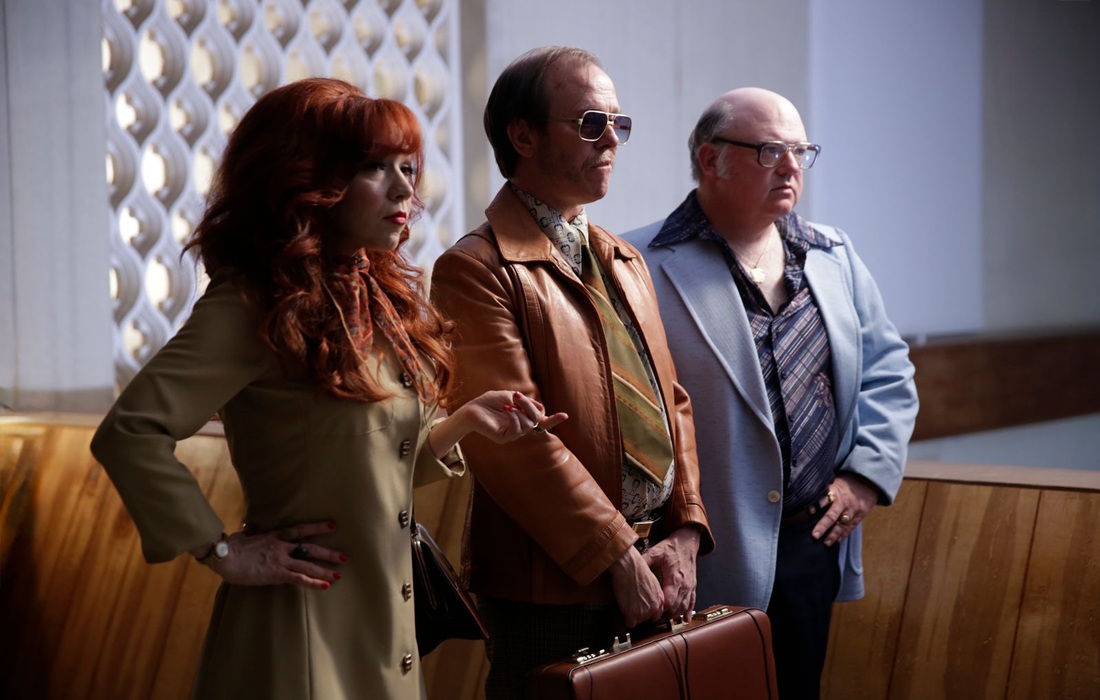
A Blind Bargain is set in 1970, although I don’t feel that the timeline impacts the story in any way. Although Dominic served in Vietnam, this aspect of his life serves no real importance other than to provide an origin point for his addiction. This said, A Blind Bargain does a commendable job of looking the era as far as clothing, home decor, and automobiles go. (Have I ever mentioned just how much I love wood panelling?) Adding to this aesthetic is the fact that the film was shot on Kodak film… and it shows. There’s actual film grain present! Not that digital bullshit sometimes used to make films look older or damaged, usually to the opposite effect.
Despite possibly being best labelled as a “psychological thriller”, A Blind Bargain doesn’t have nearly the amount of “twists & turns” that have become commonplace and cliched in the genre. In fact, the film’s biggest surprise may be in just how subdued and restrained Glover’s performance is. In spite of the bizarre behavior that the actor has become associated with over the years, Glover plays the role in a fairly straightforward manner, which I do believe helped the film from potentially wandering off into self-satirization. Horowitz also does an excellent job, albeit of convincing the viewer just what a cowardly and desperate piece of shit Dominic has allowed himself to become. Mayes also has some fun moments as the local drug lord who seemingly EVERYONE knows, providing the film with not only a few humorous retorts, but one of its few rational characters. Well, “rational” compared to most of the others.
However, the show is frequently stolen by Jed Rowen as “Logos”, Gruder’s faithful assistant, and one of the doctor’s patients. Logos is undoubtedly more than a little crazy, but seems generally harmless… until he’s not. Logos is also a devoted fan of Joy’s, having seen all of the woman’s films, and harbors something stronger than “infatuation” for her. This is only exacerbated when Joy comes under Gruder’s care. This said, the character provides more than a few light-hearted, comedic, and even sentimental moments and could almost be seen as “lovable”. Ya know, if he weren’t extremely dangerous.
Of course… it would be unfair to continue on without pointing out what I perceived as a possible negative or two.
First, and by far the most minor, is that the rear-projection effect used for A Blind Bargain‘s driving sequences may seem poorly achieved to some viewers, especially when first witnessed. However, as this is quite similar to how the effect was often achieved in older films, and as A Blind Bargain is set in and does attempt to look like a bygone era, I’m willing to overlook it. Next is the somewhat questionable inclusion of two songs in the film, including one that is presented as a performance in a musical. While I do understand that this is a stylistic approach that director Bunnell is somewhat known for, it’s one I’m rarely appreciative of. In this instance, not only do these moments stand in contrast to the rest of the film, but the songs do not remotely fit the era that the cast and crew spent so much time and effort trying to recreate.

Without question, what viewers may question most about A Blind Bargain is plausibility, or perhaps gullibility. While I have no doubts that drug addiction prevents those under its grasp from thinking clearly and logically, I still believe that Dominic should have sensed something suspicious during Ellie’s phone call, if not the initial visit. Even Joy walks deep into the proverbial “lion’s den” before ever truly sensing that something is amiss. There’s also a “message” to be found late in A Blind Bargain‘s runtime regarding “true love” and “thinking young” that, although true and respectable, is delivered in such a ham-handed manner that even more sentimental viewers may find their eyes rolling.
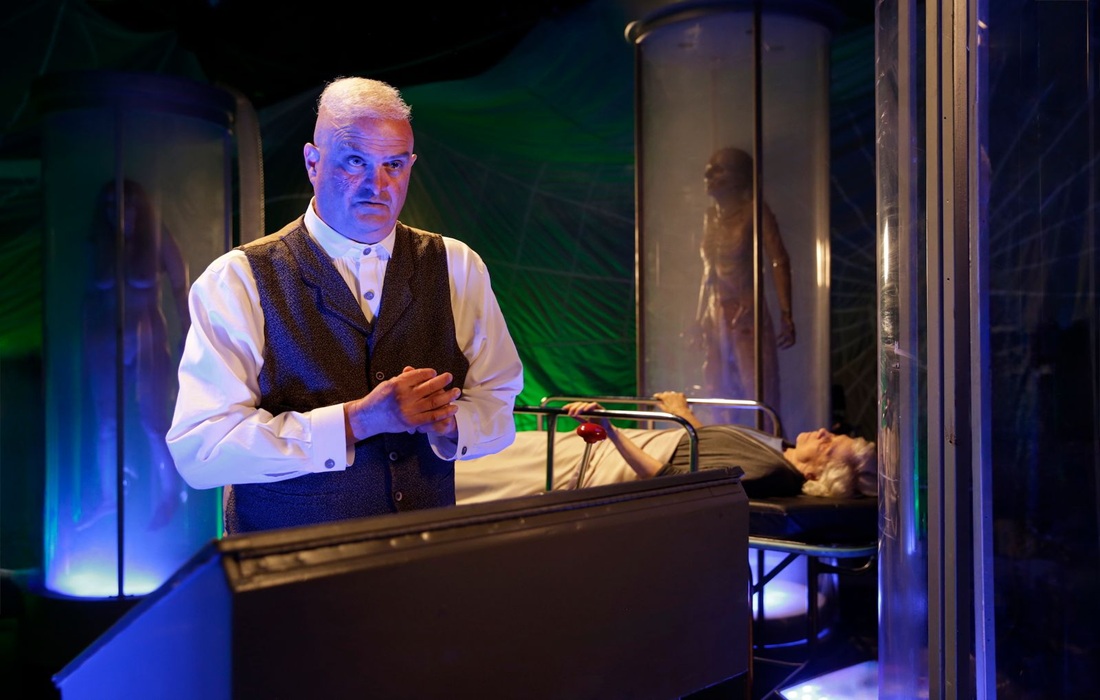
At the end of the day, I was surprised by how much I enjoyed A Blind Bargain, admittedly expecting something much more hampered by a lack of restraint. I never found myself losing interest in the film’s central plot, although it did occasionally feel as though Bunnell got distracted setting up side stories that not only never play out, but may not have relevance to the plot anyway. This said, if you look at the film as something of a distorted fantasy or daydream, similar in spirit to television series like “Twin Peaks” or “Northern Exposure”, it just seems to gel more. I reference the latter show in particular as what made it successful was not its lead, but instead its cast of quirky and eccentric supporting characters. There’s also some notable 1950’s sci-fi elements to be found, particularly in the set design for Gruder’s laboratory, which you know I absolutely adored.
Clearly, A Blind Bargain won’t be up to everyone’s tastes. Nothing is. That said, I’m glad I gave it a chance. Bunnell clearly shows imagination and talent, but may occasionally have tried spinning too many plates at once, so to speak. Granted, I’d have loved to have seen where some of those wild tangents lead.
To learn more about A Blind Bargain, and to find theaters and showtimes, visit: https://www.ablindbargainmovie.com/

