
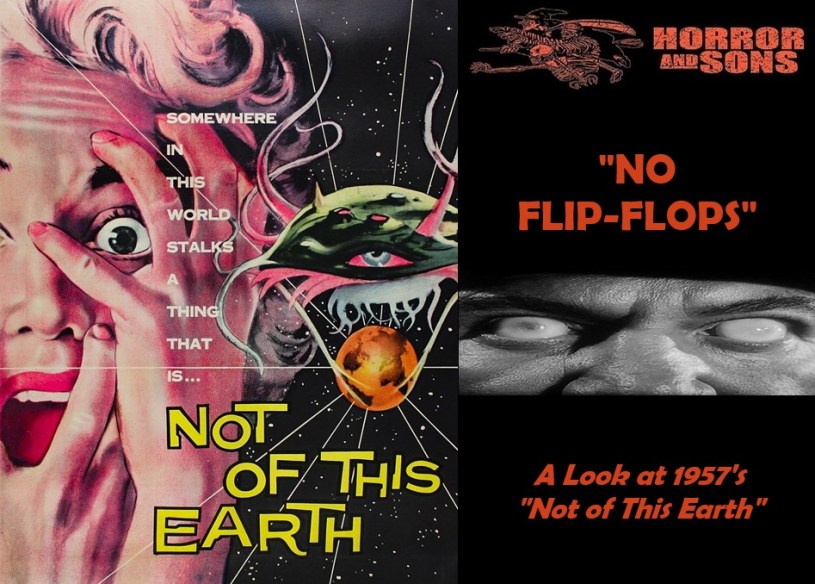
Don’t want to read the following 2,600 word retrospective? Listen to me read it instead! Click the audio link above to hear our 1st recorded review!
An alien from the war-torn planet of Davanna is sent to Earth on a mission to collect the one substance that may prevent the extinction of his entire race from a strange plague that causes their blood to essentially evaporate. That substance? Why, human blood, of course!
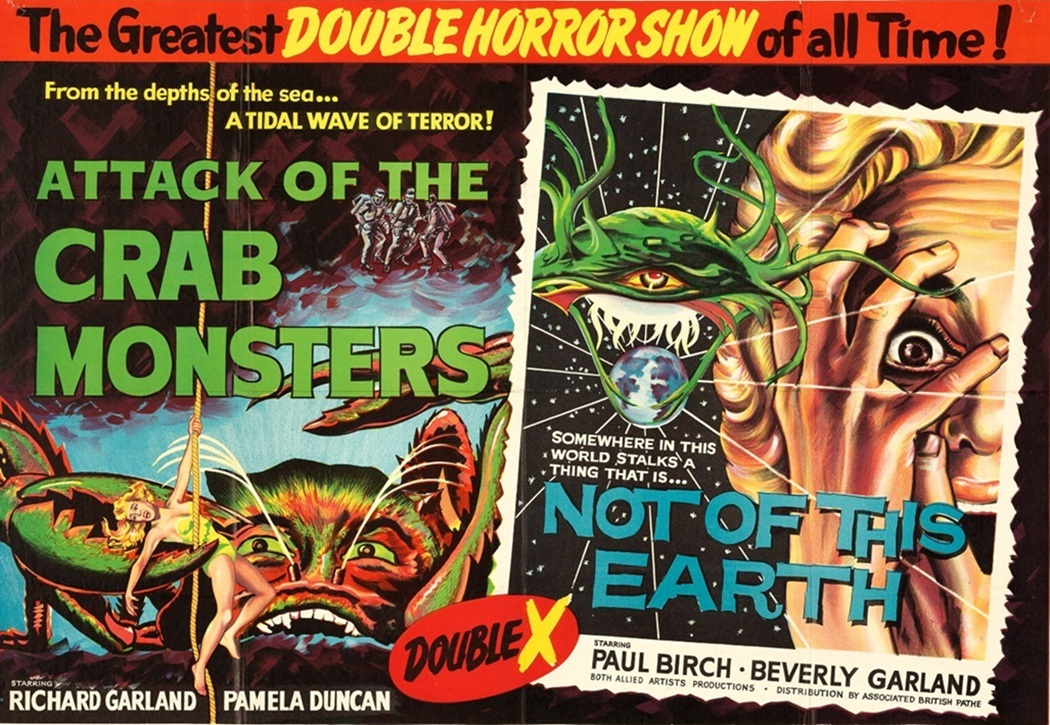
This is the general premise of 1957’s Not of This Earth, a “part science fiction/part horror” film written by Charles B. Griffith and directed by the legendary Roger Corman. Corman also produced the film, as well as came up with the original concept. As Not of This Earth is widely regarded by many fans and critics as a “classic” of both genres, chances are that you know all this already. Not of This Earth was released as the second half of a twin-billing with another classic Corman “shocker”, Attack of the Crab Monsters. If you’ve followed this site for any time, then you probably know how much I adore that film. If you somehow haven’t watched Attack of the Crab Monsters before… seriously, stop listening to this review and go watch it right now! It’s available for free on Tubi, so you really have no excuse to not watch it. Seriously, go! We will wait for you!
(Fuck ’em. We ain’t waiting. Back to the review.)
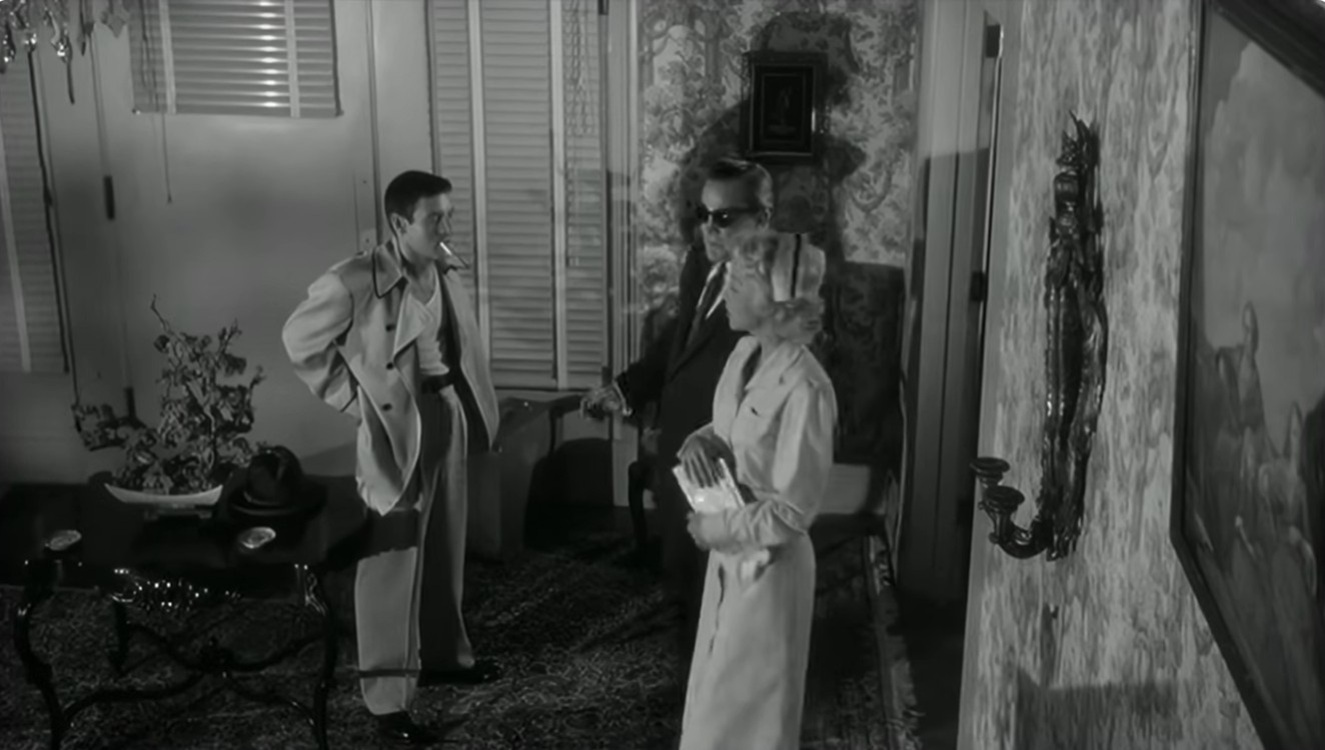
To accomplish its task, the alien, who uses the alias of “Paul Johnson” while here on Earth, has the ability to subdue and even kill with just a glare from his (near) pupil-less eyes. Johnson (played by the original “Marlboro Man”, Paul Birch) also possesses the power of hypnotism, which he uses to make certain individuals follow his every command… usually to certain doom. Johnson’s biggest weakness, however, is loud noises, which cause him great discomfort and pain. As we learn later in the film, loud noises or sounds will also break any hypnotic hold he has over an individual.
As the film begins, Johnson has just arrived at the office of pathologist Dr. Rochelle. Well, that’s not quite true. The film actually begins with Johnson killing a teenaged girl and draining her blood with some sophisticated-looking syphoning device that’s built into his briefcase. This is followed by the visit to Rochelle’s, where Johnson is greeted by the man’s nurse, Nadine. “Nadine” is played by Beverly Garland, who is probably best known for later roles on television shows “My Three Sons” and “Scarecrow and Mrs. King“. Garland would also be romantically involved with Corman for some period of time, which surely had nothing to do with her appearing in multiple films for the director/producer, such as Swamp Women, Gunslinger, and It Conquered the World.
Johnson demands a blood transfusion, but is advised by Nadine that he will first need to submit a sample in order to determine his blood type. However, Johnson adamantly refuses. That said, Rochelle still admits the man into his exam room. Here, Johnson finally submits to the blood sample… which he provides by slashing himself with a scalpel. Surprisingly, there is little blood shed by the injury. So little, in fact, that you don’t actually see blood in the scene. Johnson attributes this phenomena to the mysterious disease afflicting him. Using his hypnotic powers, Johnson coerces the doctor into devoting all of his time and energy into determining the cause of this condition, as well as a cure. This said, he has placed a mental “hold” over the doctor, preventing the man from discussing the matter with anyone.
Johnson does indeed get his required transfusion of blood, which is administered to him by Nadine. Chatting with the woman during the procedure, Johnson offers to employ Nadine as his personal nurse. Although the pay is more than she normally makes, Nadine is hesitant, but accepts the position after Johnson manipulates the doctor into prescribing him nightly transfusions as part of his “treatment”. This requires Nadine to take up temporary residence at Johnson’s home, where she quickly discovers that she is not the only person employed by the strange man.
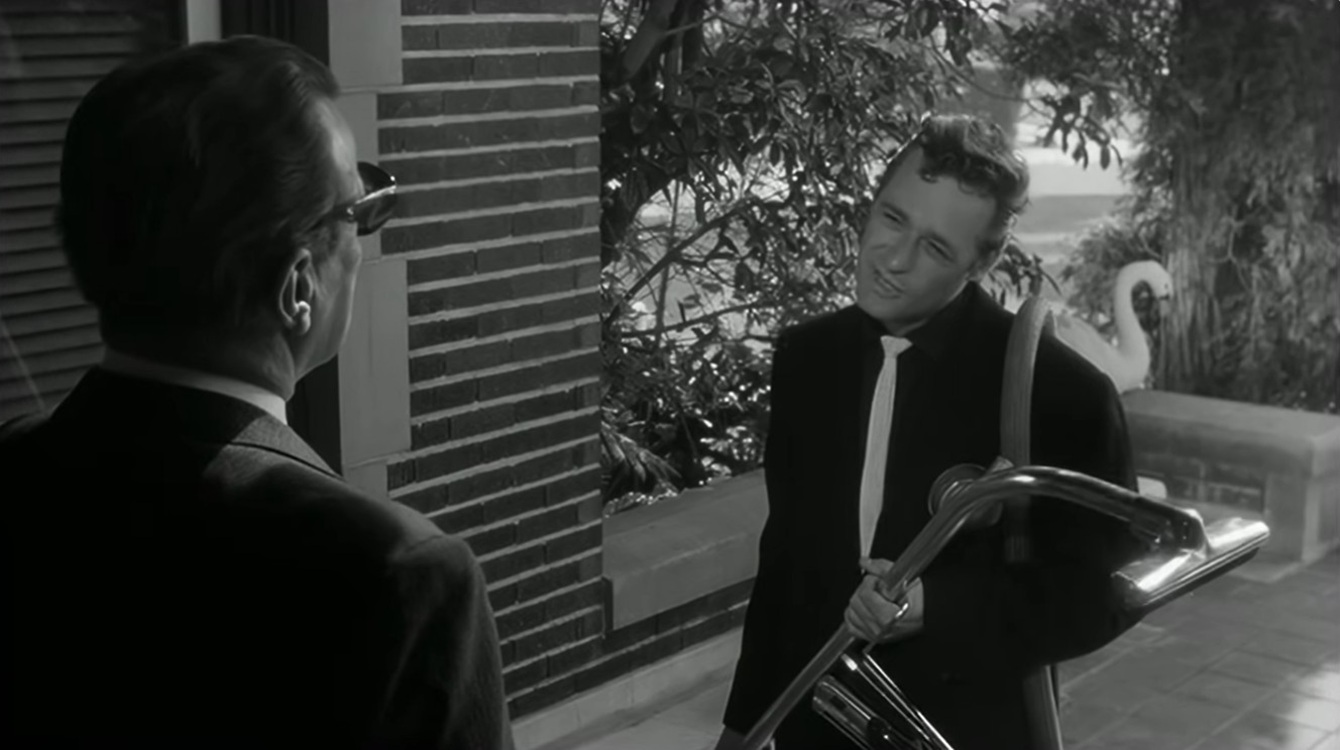
Also employed by Johnson is a weaselly two-bit crook named Jeremy, played by Jonathan Haze, who serves as the man’s chauffer and butler. Despite the steady “legit” paycheck, even Jeremy finds his new “boss” to be more than a little strange and suspicious. For any readers who might not be aware, Haze was another early Corman regular who appeared in films such as Viking Women and the Sea Serpent and The Terror, but is undoubtedly best remembered as “Seymour Krelborn” in the original 1960 production of The Little Shop of Horrors. Despite his checkered past and the “workplace sexual harassment” that he constantly peppers Nadine with, Jeremy proves to be a fairly good-natured guy and a valuable ally to the young nurse.
Meanwhile, from the privacy of his bedroom, Johnson uses a large device that he keeps concealed behind a retractable wall to communicate with an envoy from his home world. This envoy relays to Johnson the various “phases” to the mission. One might think that the alien spy would have been debriefed on his mission before arriving on our planet, but nope. Either way, his mission basically consists of collecting more human blood, but also living specimens for transmission back to Davanna for use in researching a cure to the plague. These specimens and samples are to be transported using the same communicator device. Granted, the prop used is little more than a rectangular frame of brass piping that had some ping pong balls glued to it and then got shoved in a closet. The floating disembodied head of the Davannian envoy? Nothing more than the film’s AD in a black turtleneck sweater. Yet, somehow, it still works wonderfully.
Of course, this is an early Corman film. So, none other than (my favorite actor) Dick Miller soon shows up in an incredibly brief, but highly memorable role as an insistent door-to-door vacuum salesman who becomes one of the first of the alien invader’s many on-screen murders. While happily admitting my bias, I do feel that Miller almost steals the show here with his comical, yet always charismatic and relatable personality and delivery. Instead, he only finds himself being shoved feet-first into a furnace. As if to rub some salt in the wound, a joke is made at the ill-fated character’s expense later in the film, and by a police officer of all people.
To help in obtaining this required blood supply, Johnson has Jeremy drive into town and lure a group of homeless men back to the house with the promise of free food and drink… which, really would be enough to get me to follow you most places too. Although it’s a fairly cold-blooded charade that Johnson is carrying out, the scene of the men’s deaths is played quite literally without a “straight face” and clearly for laughs. Johnson later hypnotizes a Chinese man that he encounters while out prowling for blood. Returning to his house, Johnson forces the man to enter his matter transference/communicator doohickey as the first of the living specimens to be sent to Davanna. However, the alien later learns that the effort was futile as the human was flattened by gravitational forces and no longer suitable for use in research.
Eventually, Johnson happens upon another of his kind; a younger female who admits to having fled Davanna to our world through Johnson’s transporter. The woman reveals to Johnson that war on Davanna has long since ended, and that the planet’s leaders have been despotically keeping the obtained blood supply for themselves. Even more appalling, they have begun killing their own people in order to sustain their continuingly decreasing blood supply. Even in light of these revelations, Johnson carries on with his mission undeterred, exposing him as just an unquestioning soldier blindly following the orders of his superiors. In essence, Johnson is a drone, which makes the character seem more robotic and/or insect-like in behavior, thus making him both a little more frightening and somewhat more tragic than he initially seemed.
However, the fate of this new compatriot may be the film’s most tragic. In order to save his new friend (and potential future “mate”), Johnson takes medical matters into his own hands and breaks into Rochelle’s office, where he injects the woman with a vial of stolen blood. Although he has become quite well-versed in a multitude of Earth languages, Johnson manages to miss the label on the bottle indicating that it’s actually filled with rabies-infected dog blood. Fun times ahead!
Although the two aliens go their separate ways later in the evening, the woman is ravaged by this new, additional disease that has found its way into her body, but manages to stumble her way back to Rochelle’s office before meeting her demise. Her off-screen autopsy is the evidence that finally exposes Johnson’s true nature to everyone. Well, everyone except the essentially brain-washed Rochelle, who still can’t discuss the alien or its condition even after Johnson has been outed.
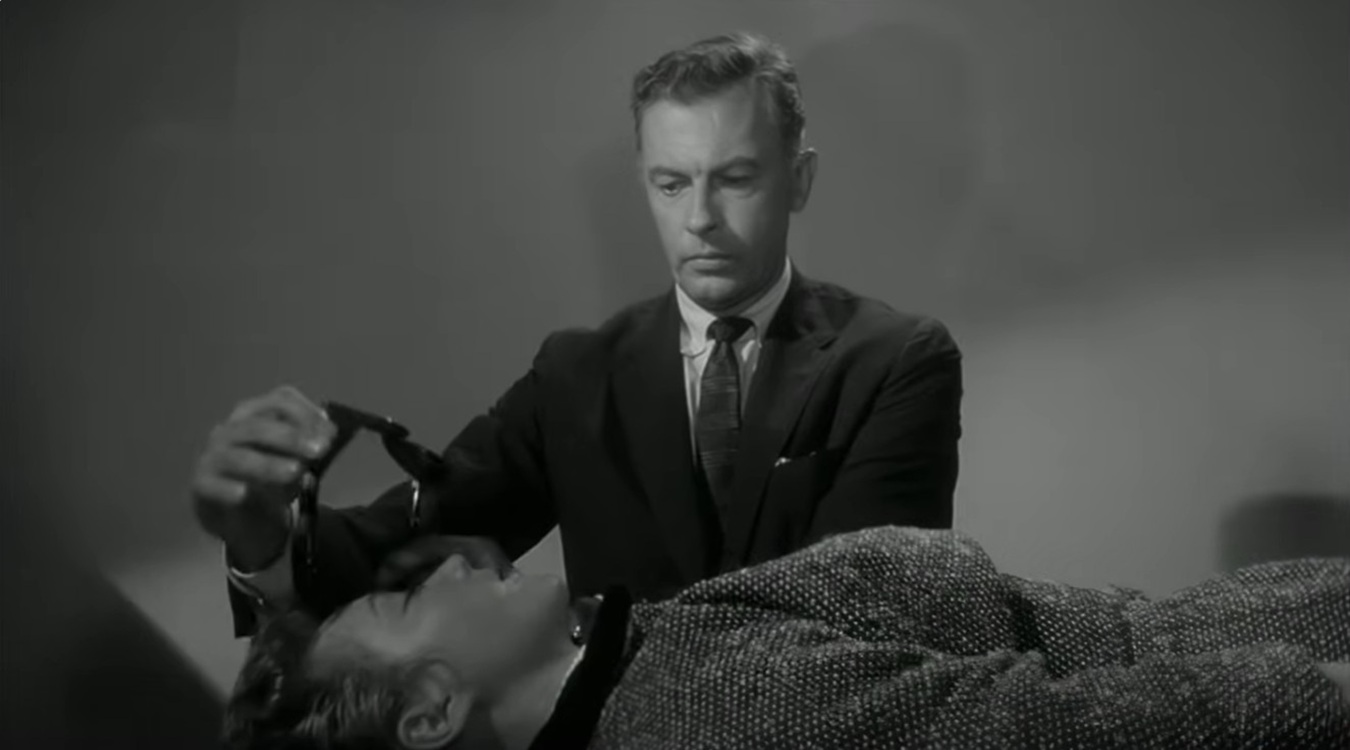
Johnson manages to claim a few more victims, including a couple key supporting characters, before finally turning his sights on Nadine. However, instead of just killing the woman and draining her blood, Johnson instead chooses her to be the next “specimen” sent through the transporter… even though he has already quite explicitly been informed that the woman would only end up quite smushed and unsuitable for…. well, for anything other than maybe being a doorstop.
As one should probably expect, Johnson meets his own end before this can happen. This said, the means to his demise is telegraphed quite early on in the film and seems like something that could have been not only a serious problem for Johnson whenever he ventured into town on one of his little walks, but also a rather common occurrence. Given all of the events leading up to this, the resolution does feel somewhat anti-climactic. Not of This Earth ultimately concludes in somewhat silly fashion, while also leaving the door open for sequels that never materialized. Honestly, I’m somewhat glad they didn’t as everybody knows that sequels tend to be inferior films.
The same can usually be said for remakes. Granted, this didn’t stop Roger Corman from producing two remakes of Not of This Earth because, hey… if there was a dollar to be made, Roger was going to make it! The first of these remakes surfaced in 1988 when director Jim Wynorski (of Chopping Mall fame) bet producer Corman that he could shoot the film in only twelve days. He finished in eleven. As the script is frequently a word-for-word transcription of the original, and as large sections of the film (including the entirety of the opening credits) are comprised of nothing but clips from earlier Corman sci-fi and monster films, there’s some argument as to whether Wynorski actually won that bet. While the film’s marketing gimmick (and clearly what it’s still best remembered for today) was the casting of Traci Lords in one of her first “mainstream” (aka “not porn”) roles, Wynorski’s Not of This Earth is a really fun spoof of the original, as well as a little bit of a love letter, and shouldn’t be missed by fans of the original film. That is, as long as they aren’t bothered by a plethora of late-80’s era plastic boobies frequently on display. Nah. Of course you aren’t.
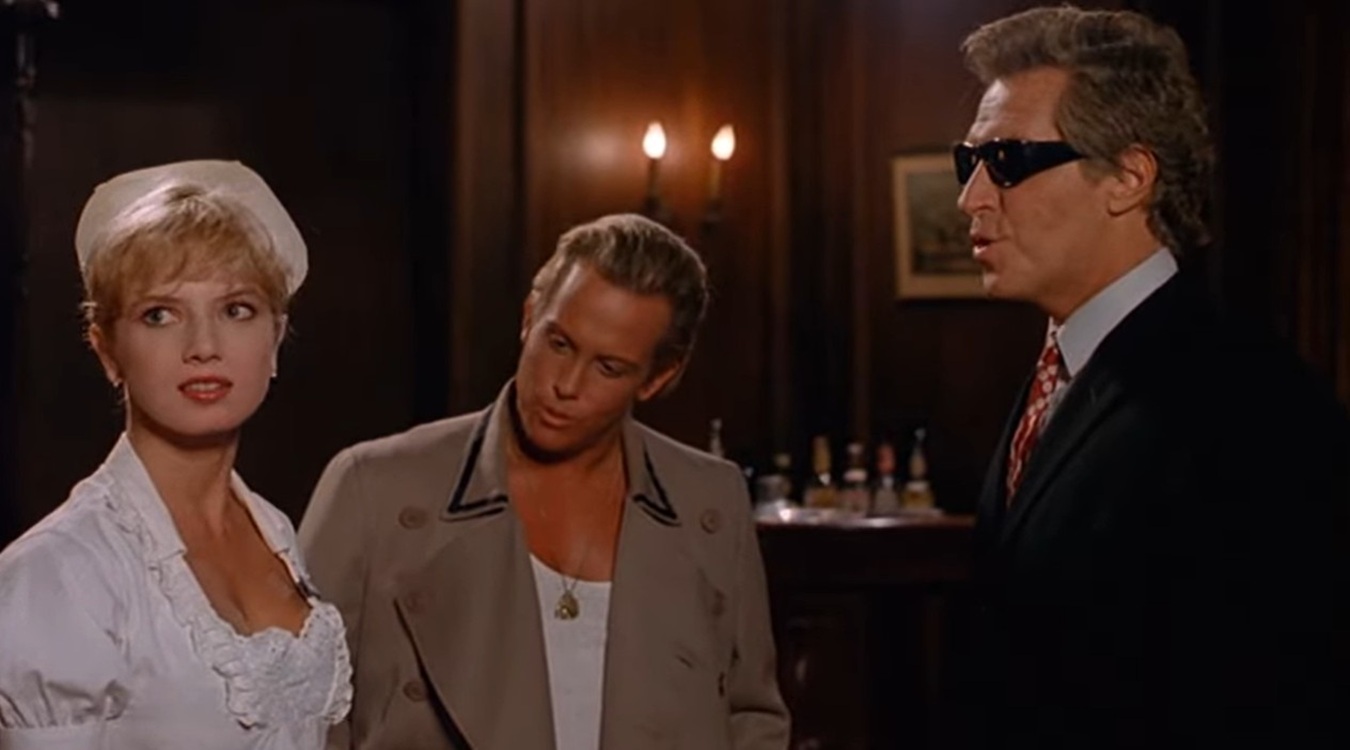
Not of This Earth reappeared in 1995 from director Terence H. Winkless as part of the “Roger Corman Presents” series of older Corman films that were remade for the Showtime cable network. Winkless had previously directed the gross-out 1987 “roach horror” film, The Nest, and 1989’s chop-sockery fest, Bloodfist for Corman. He’s also directed a shit ton of Power Rangers projects over the last 30+ years, and you can see aspects of each in his version of the film. Elizabeth Barondes, who appeared in the direct-to-video Night of the Scarecrow the same year, is cast as the nurse here, but takes something of a backseat to Michael York of Logan’s Run fame as “Mr. Johnson”. The film also features Parker Stevenson, Mason Adams, and Richard Belzer as “Jeremy”. Winkless does up the gore and takes the film into much darker territory, such as further exploring the “hive-mind” aspects of Davannian society or by presenting Johnson’s ailment as akin to AIDS/HIV, but the production is just too sloppy and uneven to take seriously, with visual effects that have not aged kindly.
It would seem that most of the original film’s cast and crew enjoyed working on the production, or (at least) tolerated the experience. As noted previously, Beverly Garland, Jonathan Haze, and Dick Miller all worked with Roger multiple times over their careers. “Monster Makers” Paul Blaisdell and Bob Burns, who are rightfully considered “icons” by an entire generation (and then some) of “monster kids”, are on-hand to provide the film’s rather limited effects. Their “crowning” achievement here is probably the somewhat under-utilized “umbrella monster” that takes out one of the film’s supporting characters by eating their head. (Again, more implied than shown.) Composer Ronald Stein is also present to help keep things moving along. For what it’s worth, Stein’s piece, “The Catacombs”, which is used during the opening credits of 1963’s Dementia 13, is probably my favorite theme to any horror film, and its presence is just as welcomed here.
However, one person who did not enjoy working with the filmmaker was Paul Birch, who is said to have walked off the film after having some sort of altercation with Corman. It’s reported (by some of the film’s cast and crew, no less) that Birch did not enjoy the fast-paced, “one take and done” approach that Corman took to his films, nor did the uncomfortable plastic “contact lenses” that the actor was forced to wear for extended periods help matters. It’s even alleged that Birch found the subject matter “beneath” him. I’ll just assume that he was referring to the more horrific aspects of the film as Birch had previously appeared in other sci-fi films, such as War of the Worlds, The Beast with a Million Eyes, and even Corman’s own 1955 film, Day the World Ended. Birch also appeared in 1952’s Bonzo Goes to College, so takes these claims as you will.
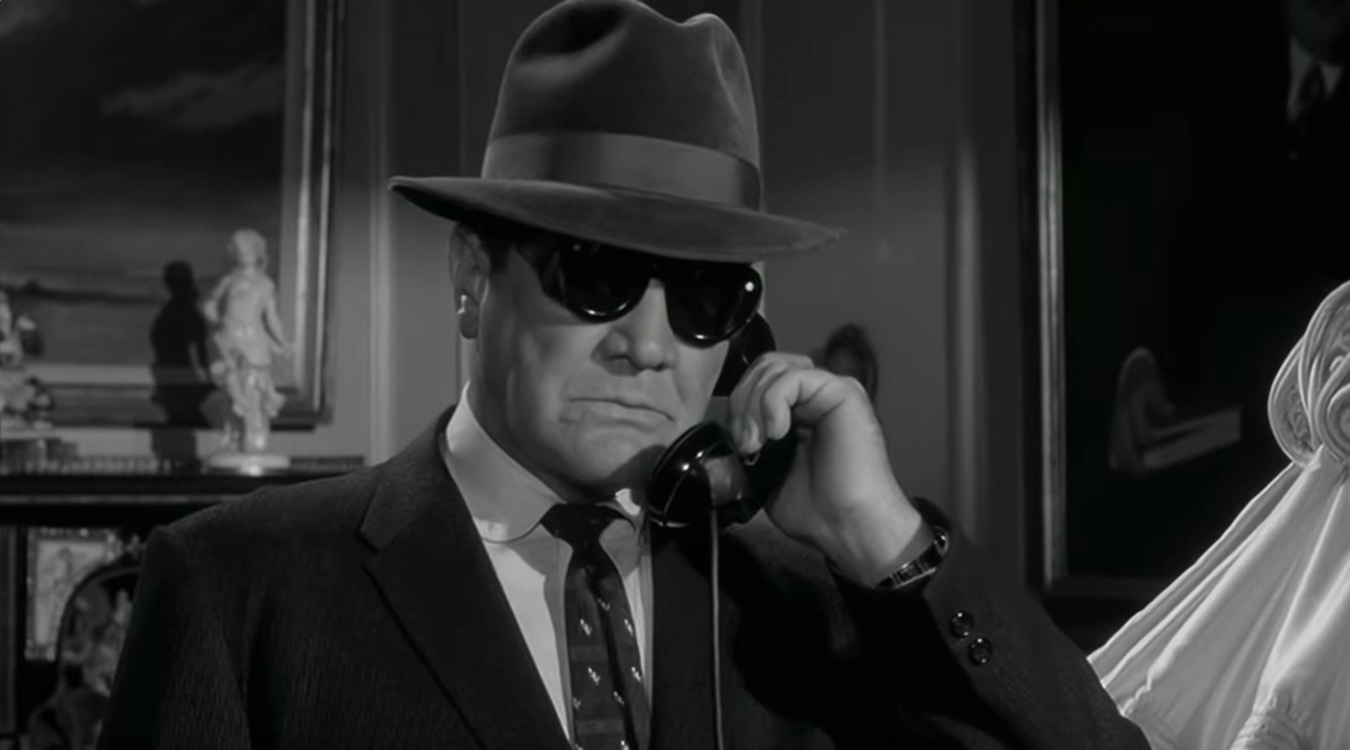
Whatever Birch’s thoughts on the production, this particular reviewer unabashedly loves Not of This Earth. Like many of Corman’s genre works from the era, the film mixes elements of sci-fi, horror, and comedy with a pinch of social commentary and produces something that successfully fills its albeit incredibly brief 67-minute runtime with clever ideas and interesting (and often quirky) characters while still moving briskly enough to prevent from ever getting boring. One can even argue that Not of This Earth presents cinema’s first example of “space vampires”, beating Mario Bava’s Planet of the Vampires to the screen by five years and appearing long before British author Colin Wilson’s 1976 novel “The Space Vampires”, which served as the basis for Tobe Hooper’s 1985 film Lifeforce.
That said, I don’t really look at it that deeply. For me, Not of This Earth is just an entertaining movie with some fun performances, a few clever ideas, and a ton of charm. As I tend to have an incredible fondness for genre filmmaking of the 1950’s, Not of This Earth also benefits from featuring some recognizable faces. I consider it a “comfort movie”. A “digestif”, if you will; one that I frequently turn to on late lazy nights when I just want to watch something familiar, but also not overly demanding of my attention. What can I say? It just makes me happy.
How much more can you really ask from a film?


I dig the new format. It’s a nice option to have.
LikeLiked by 1 person
Great write-up! When I first saw this, I was a bit underwhelmed– although the flying, blood sucking umbrella certainly got my attention! When I got a little older, I could better appreciate the Dick Miller scene, Beverly Garland, and the dialog about politics on an alien world. Now it’s a favorite sci-fi film from that era.
LikeLiked by 1 person
Thanks, Brian! I think I focused a little too much on the budgetary setback when I first watch the film, finding it kind of silly. That said, it definitely grew on me with rewatches.
LikeLike