
For any readers that consider themselves serious or avid collectors of films on physical media, whether that be horror or any other genre, I’m sure you’re well aware that finding certain titles for your collections can often take some dedication… and more than a few dollars. I’m sure that you’re just as familiar when the sense of joy and accomplishment that comes with finally tracking down an elusive copy of the film that has evaded your grasp for so long, often an obscurity that seemingly no one but you cares about. Besides serving as a brief review of an early work from a “Master of Horror”, today’s Halloween Horrors entry also looks at both sides of that situation, and I’m certain many film collectors will surely relate.
Please welcome our friend Jennifer Upton back to the Halloween Horrors series. In addition to being the author of the book “Japanese Cult Cinema: Films from the Second Golden Age”, guest contributor on sites such as BAndSAboutMovies.com, and regular host on the Drive-In Asylum Double Feature web shows, Jennifer also recently served as an editor for Fred Olen Ray’s autobiography, “Hellbent for Hollywood“, which you can and should purchase here (LINK). As always, it’s a true honor and pleasure to have Jennifer contribute to this series!
Here’s today’s Halloween Horrors look at…
Four Flies on Grey Velvet
By Jennifer Upton
The release history of Four Flies on Grey Velvet is the stuff of legend.
My personal history with this film is similar to that of many others. During the early ‘90s, I gorged on the back catalog of Dario Argento. Due to rights issues with Paramount, this was the one film that continuously eluded fans. Every time I tried to buy a copy at a convention, it was sold out. When I finally got a hold of one, the quality was so poor, I felt I couldn’t judge the film properly. For years, I searched for a better copy, but most were pretty bad and eventually I gave up.
It would be another three years before the film’s first official North American release in 2009. Once again, I was disappointed with this VHS, as the transfer was simply a copy of an older French VHS release; the same one I already purchased on the black market. MYA’s DVD release that same year was missing footage. Would I ever see this celluloid cryptid in the wild? Not if Paramount had anything to say about it.

In April 2006, I attended a sold-out screening in Los Angeles at the Egyptian Theatre as part of their Giallo Festival, where they also screened Lucio Fulci’s The Psychic (1977), Umberto Lenzi’s Paranoia (1970) and another Mimsy Farmer-starring Giallo, Autopsy (1975.) Everyone in that theatre knew we were watching the sasquatch of Argento films, and the audience ate it up. Since that night, I hadn’t seen the film again until I streamed the crappy Shameless DVD version for this article.
Fran Lebowtiz once called Four Flies on Grey Velvet the worst movie she had ever seen. I vehemently disagree. It’s a very good film. Perhaps not as a good as Profondo Rosso, but as the third in the Argento’s original animal trilogy, it’s a stepping stone to his peak period that would begin a few years later and last into the ‘90s. Upon its release, Four Flies was Argento’s most visually experimental. The film that set the groundwork for all the amazing camerawork that came later.
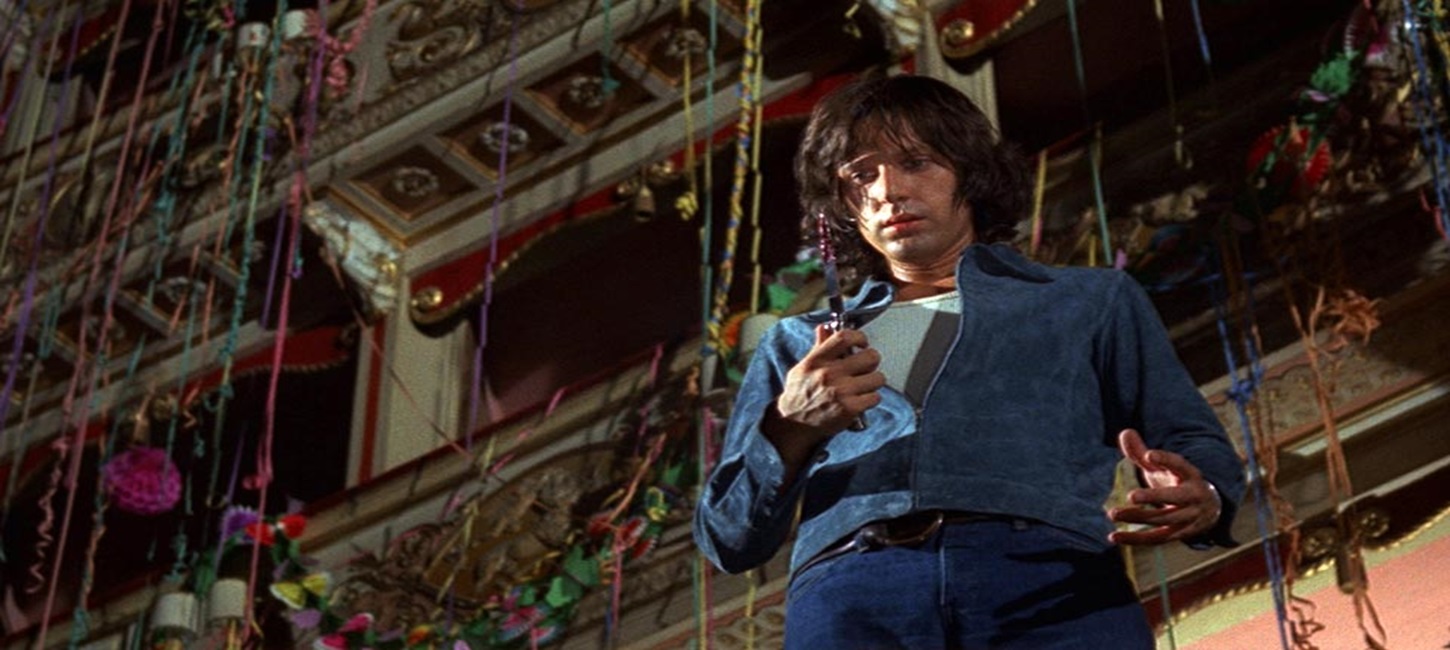
The plot concerns Roberto Tobias (Michael Brandon), a prog rock musician who accidentally kills his stalker and then gets stalked again by a nameless tormentor who witnessed the crime. As with all giallo, the list of suspects is soon whittled down in a series of great kills, leaving only two characters Roberto can trust.
The first is his eccentric friend Godfrey, aka God, played hilariously by Bud Spencer. God is immediately deemed trustworthy as evidenced by his warm relationship with his pet parrot, “Jerk-Off”, who was (according to God) bequeathed the moniker upon hatching, “…and so I had to keep it.” The second is his wife Nina, played by the adorable Mimsy Farmer, who gives us absolutely no reason to NOT trust her. And thus, we have our killer. Her motive? Roberto looks like her abusive dad, who wasn’t even really her dad. It doesn’t have to make sense. It’s an Argento giallo. We’re not here for the logic. We’re here for Mimsy freaking out in the best way possible during her confession speech, and for the visuals.

We all know that the plots in Argento’s films are generally only pretexts for him to hang his increasingly elaborate horror set pieces upon. This film delivers in that area. It also features a lot of the visual and thematic material he would explore in later films, such as the subjective camera parting through velvet curtains, a creepy doll mask, a crappy car with a faulty door, and a killer created through years of gender identity abuse at the hands of a parent, to name a few.
In the end, Tobias discovers his wife’s scheme through the “science” of optography, in which the last image a person sees upon death is captured on the retina. No, it’s not real science, but it doesn’t matter. What comes next is awesome. Once discovered, Nina attempts to flee and we’re treated to the best slow-motion car crash ever filmed, assisted by Ennio Morricone’s gorgeous score.

I thoroughly enjoyed watching the film again. While seeing it with a giallo-friendly audience back in ’06 was a much fuller, communal experience, complete with a standing ovation over the credits, watching it again made me seriously regret not ordering Severin’s 4K release, which itself has become a digital cinematic cryptid. To appease the rights holders, this version was only available for a single weekend in late 2022. To get it made, the guys at Severin reportedly had to fly their scanner to Italy because the print cannot leave its hiding place in the warehouse next to the Arc of the Covenant, two rows down from Walt Disney’s frozen corpse.
Its continued status as a “rare” find is only partially what makes the film special. Not only is Four Flies on Grey Velvet the best of the animal trilogy, but it’s cornerstone of everything Argento created after.
 Horror And Sons