
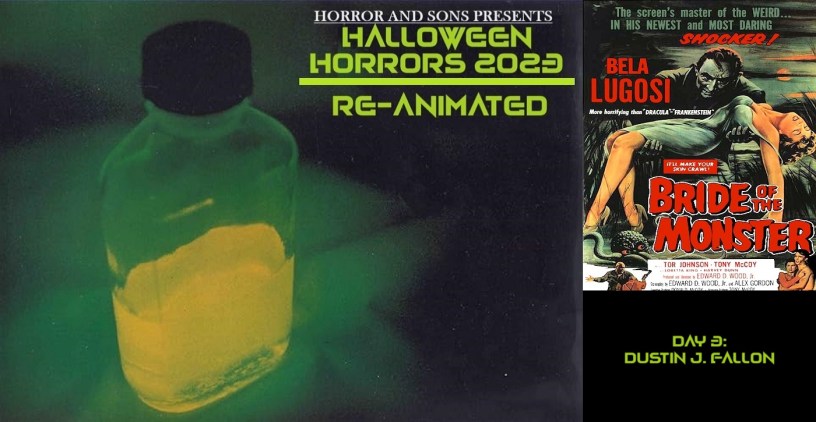
Um… I’m the guy that runs this site. So, why the Hell should I write an intro for myself? I’m the least important of the series’ contributors.
Bride of the Monster is a 1955 film directed, produced, and co-written by notorious low-budget filmmaker Ed Wood Jr. Of course, Wood is best known for Plan 9 from Outer Space, a film that, despite being featured on a few low-budget double feature bills and airing on television for years, remained relatively obscure until sometime around 1980, when film critic Michael Medved bestowed upon it the title of “Worst Film Of All Time”. Many other critics and film historians have shared this sentiment towards the film, although it’s a well-known fact that many “well-regarded” critics frequently give ratings and reviews that they don’t actually agree with just to save face with their peers and avoid criticism of their own. For example, one well-known critic (no names) once gave Weekend at Bernie’s an extremely negative review, only to later admit that they actually liked the film but had publicly trashed it because that’s what their colleagues were doing. What an asshole! As I am very much not a “well-regarded” critic, I can assure you that Plan 9 is NOT the worst movie ever made, nor is it even close.
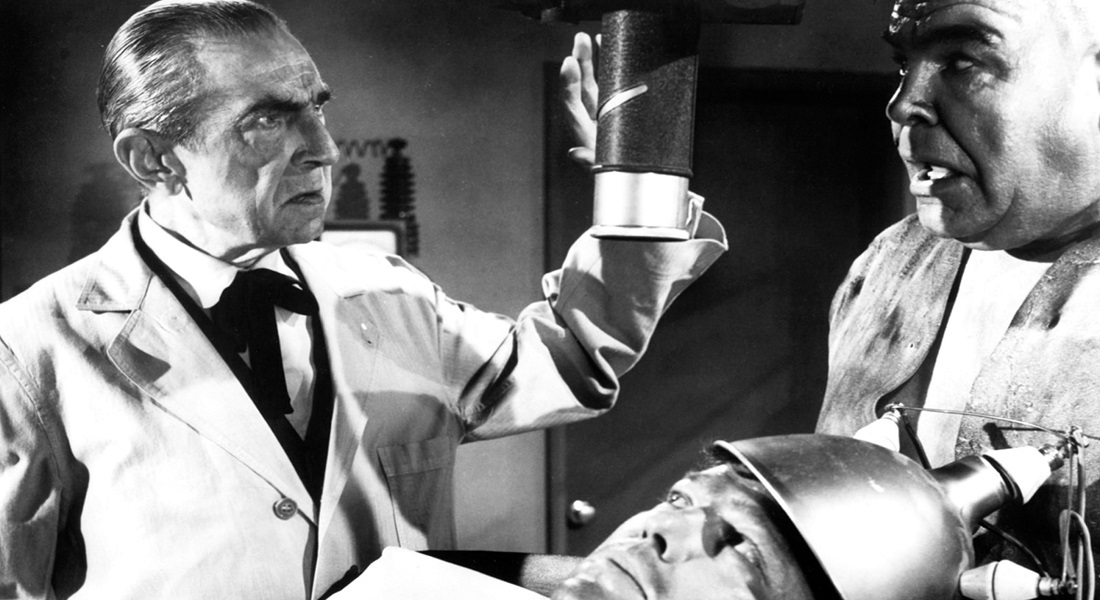
Bride of the Monster stars horror icon Bela Lugosi in what would be his last speaking role. Lugosi would later appear in 1956’s The Black Sleep, which also featured other classic horror legends, such as Basil Rathbone, Lon Chaney Jr., and John Carradine. However, Lugosi’s role in that film would be in a silent capacity, portraying a mute named “Casimir”. Lugosi also appears in Plan 9, although his role is also silent in that film, achieved through the use of archive footage from unfinished films, and (most memorably) when another actor quite unconvincingly pretends to be the then-deceased Lugosi in other scenes. A couple other Plan 9 actors, Paul Marco and Tor Johnson, co-star in Bride of the Monster as well. Maybe not-so-coincidentally, Tor Johnson would later star in 1961’s The Beast of Yucca Flats, which very well may be the actual “worst movie ever made”.
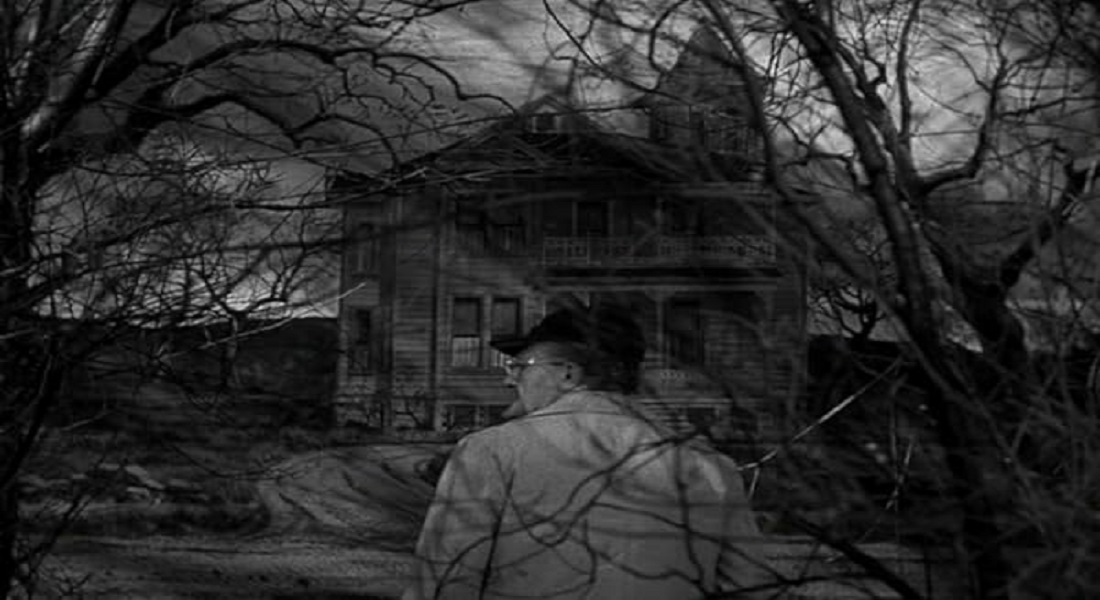
The film opens with something of a cliche, but one that’s served as the setting for countless spooky stories; an old and somewhat ramshackle house, known to locals as the Willows House, located in a wooded area on what is a dark and stormy night. Granted, there’s some question as to whether this is a real house, a model, or just a rather impressive matte painting. Whichever answer is closest to the truth is somewhat irrelevant. What isn’t is that the area around the home has been the site of numerous recent disappearances.
Two men are hunting in the area when they find themselves caught in the storm. The men seek shelter at the Willows House, believing it to be long abandoned. Sure, these men, as well as many other locals, also believe the house to be haunted, but they’re not ‘fraid of no ghost. At least, not when pneumonia is the other option. Despite thinking that the house is deserted, they still knock on the front door anyway. The house proves not to be empty when an older gentleman (Lugosi) answers the door. He rudely denies the hunters entrance and orders them to leave.
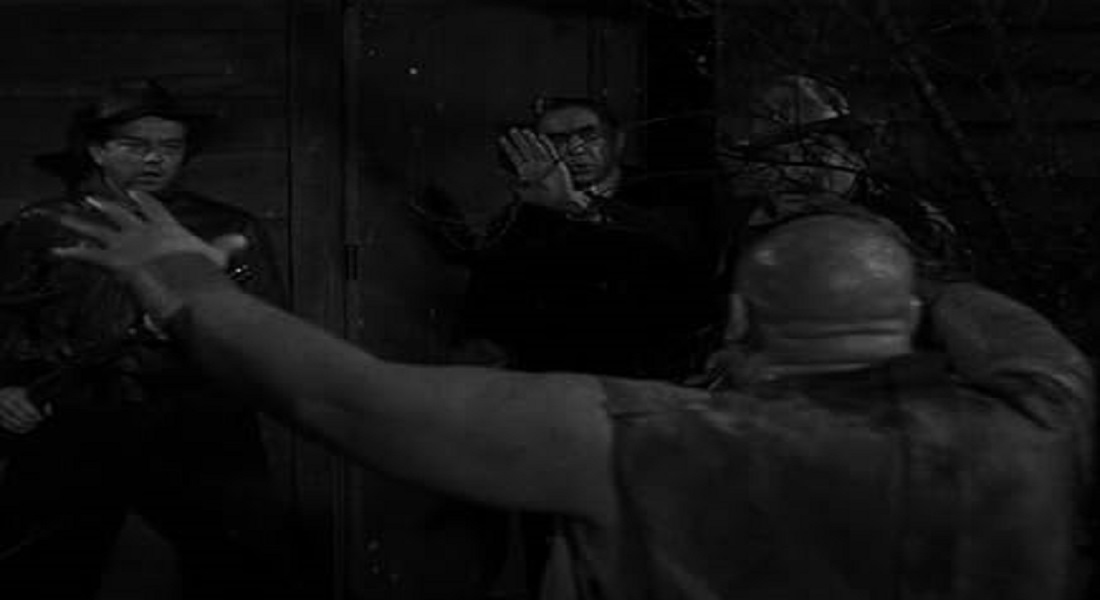
The hunters persist, but the older man continues to turn them down. Soon, they find themselves confronted by a large beast of a man (Johnson). Believing this to be the fabled “monster” that the local newspapers claim to be behind the recent disappearances, they run away. The older man laughs at the idea that this large man, whom he calls “Lobo”, could be confused for a monster, but warns the fleeing hunters that “perhaps one day you will meet the monster!” He ensures that “one day” is actually today, retreating inside the house to a secret laboratory located behind the fireplace.
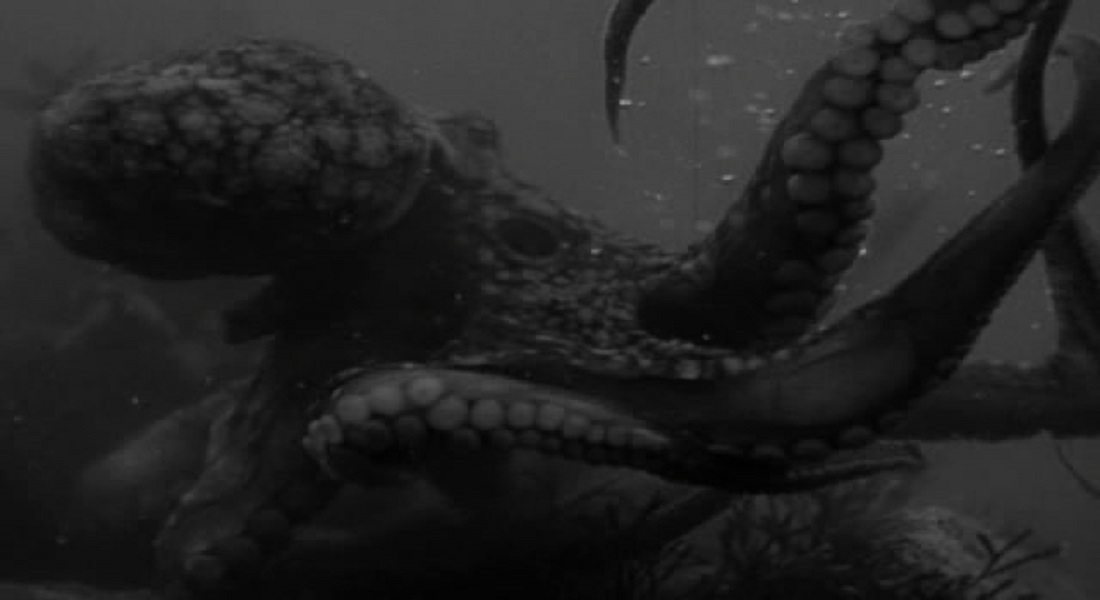
From the lab, he unleashes the real monster, a giant octopus, from its underwater lair…. which is actually just a lake seemingly located right outside the house. One of the hunters is attacked and killed by the “monster”, while the other is subdued by Lobo and taken back to the house. Here, the older man, secretly a disgraced scientist named Eric Vornoff, performs experiments with atomic radiation on the hunter in the hopes of creating a superhuman. The experiment fails, leaving nothing more than a dead body in Vornoff’s lab.
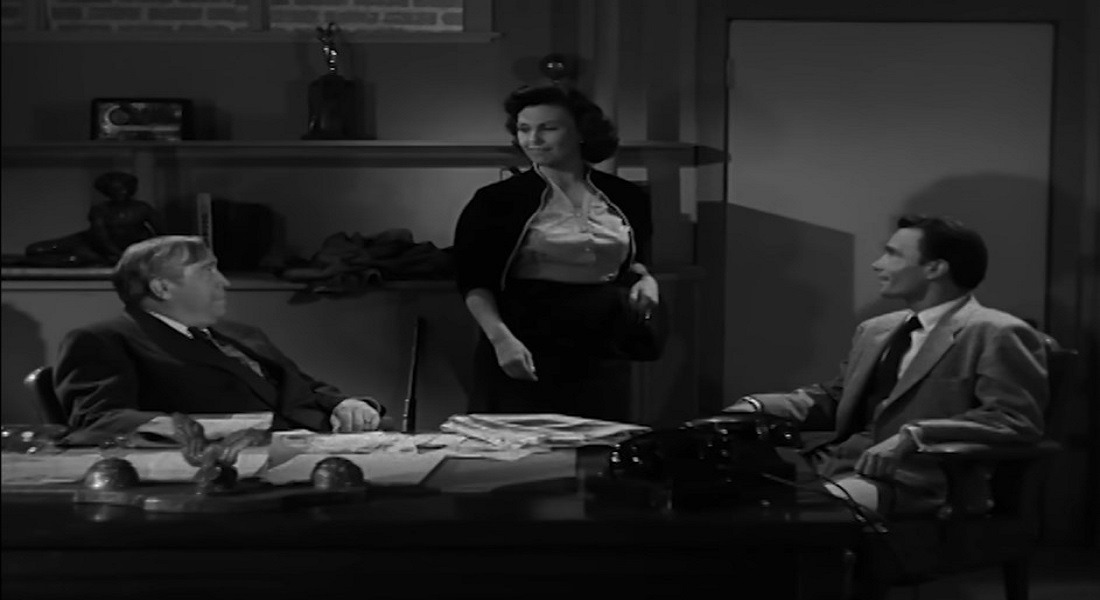
The papers soon run stories on the missing hunters, claiming that the monster has struck again. At the police station, the captain (Harvey B. Dunn, “Gramps” from 1959’s Teenagers from Outer Space) discusses the disappearance of the hunters with Lt. Dick Craig (Tony McCoy), the lead detective on the case. Craig also happens to be the fiancé of Janet Lawton (Loretta King, who also appeared in 1975’s Deliver Us From Evil), a reporter (at least partially) responsible for perpetuating the claim of a monster. As the two policemen discuss the disappearances, which they assume to be the work of gators or even quicksand, Janet barges into the office to berate both men for the lack of leads in the case. Displeased with how they are handling the case, Janet states that she will go out to the lake herself to investigate, much to Dick’s dismay.
Being a strong-willed woman, Janet does exactly what she said she would and travels out to the lake. However, upon reaching the area, her car blows a tire, which sends her plowing into some trees. Janet makes it through the crash somewhat dazed, but relatively unharmed. However, no matter how tough she may be, this is a 1950’s era genre film, so she soon faints upon witnessing the presence of a snake. This gives Lobo, who somehow happens to be waiting just off-screen, the opportunity to abduct Janet from her car and drag her back to Vornoff’s home… but not before he bashes the poor harmless snake against a tree a few times.
Meanwhile, back at the station, the captain introduces Dick to another presumably European scientist named Strowski (George Becwar, co-star of 1958’s War of the Colossal Beast) who claims to be an expert on the subject of monsters and offers his assistance to the police. The captain orders Dick to accompany Strowski to the lake the following morning to search for signs of the alleged monster. However, Strowski departs for the lake on his own, leaving Dick to investigate the area with another police officer instead. This makes one wonder why Strowski ever went to the police station in the first place.
Janet awakens at Vornoff’s, who spends just enough time informing her that she was in an accident before hypnotizing her back to sleep through the use of bending or waving his fingers and close ups of his eyes (gimmicks that Lugosi also used in films such as Dracula, Mark of the Vampire, and White Zombie). This proves to be conveniently timed as Strowski soon arrives at the home, revealing ulterior motives of his own. Again, this begs the question of why he ever wasted time at the police station, unless it was only to learn the location of the lake. One would think that he could have obtained that information by reading one of Janet’s newspaper articles, but whatever. Logic is not a key factor in this film… or most of Wood’s films, for that matter.
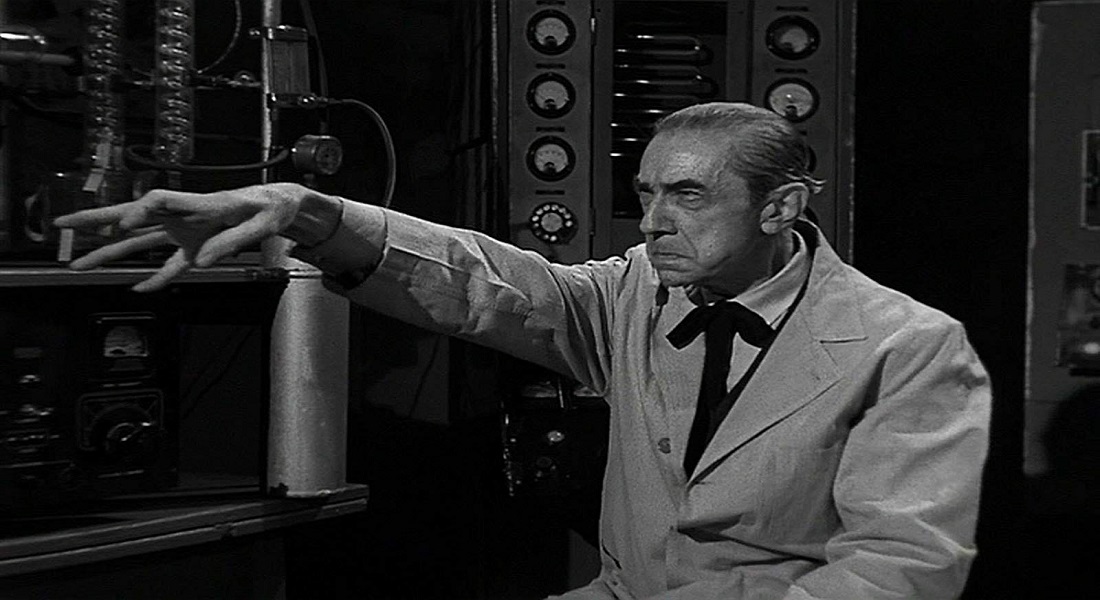
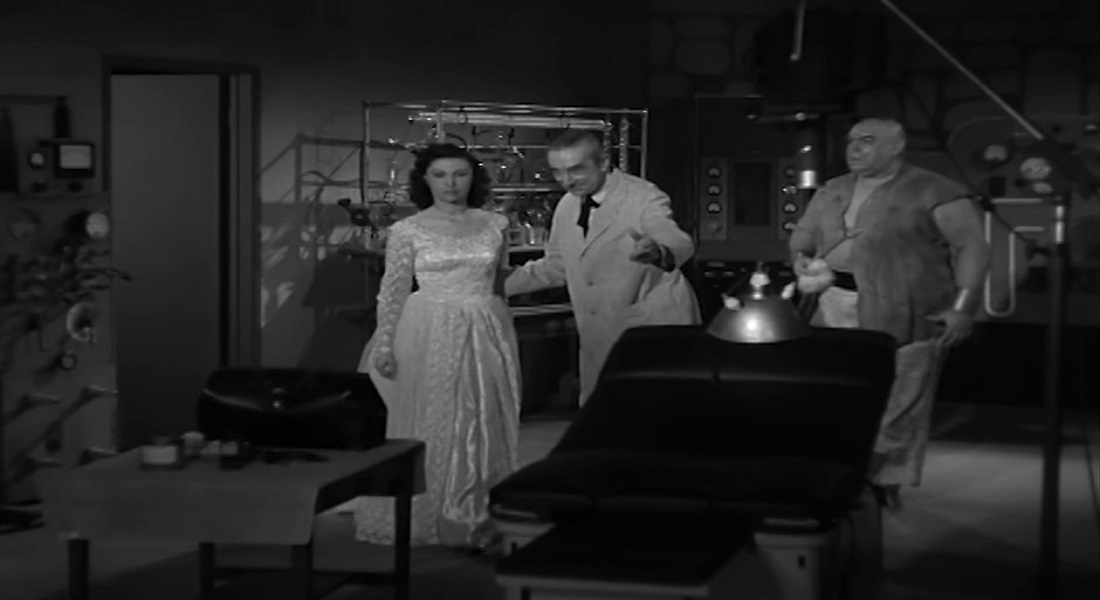
The “bride” aspect of the film’s title comes in late when Janet is dressed in a wedding dress, seemingly against her will or knowledge, just before Vornoff attempts to conduct his experiments on her. That said, there seems to be little reason or explanation for this particular action. Perhaps it was to justify the film’s title, perhaps because Wood just liked the dress. Of course, as the “damsel in distress” in many of these films never actually comes to any harm, it is Vornoff who ends up subjected to the experiment, himself becoming an atomic superman. All this really means is that he gains some strength and that bullets hurt him little. This “atomic” version of Vornoff is noticeably played by a stunt double, one who happens to be shorter than Lugosi and can clearly be seen wearing shoes with lifts installed.
The character of Lobo would reappear in Wood’s Night of the Ghouls (a film shot between 1957-1958, but which remained unreleased until 1984) and is quite similar to Johnson’s performance in Plan 9 from Outer Space. The character of the policeman Kelton (Marco) would also reappear in both Plan 9 and Night of the Ghouls.
Unsurprisingly, there’s an undeniable sloppiness to Bride of the Monster that originates to before filming even began. The script was written under the title of “The Atomic Monster” before being changed to “The Monster of the Marshes” once production began. The film eventually premiered titled as “Bride of the Atom”, only to be changed yet again to Bride of the Monster once the film received wider distribution.
As with many of Wood’s films, there were financial issues, with production stopping at least twice due to funds being depleted. Backing finally came courtesy of a meat packing plant owner named Donald McCoy… on the condition that Wood give his son, Tony, the lead role. There’s also some rumor that Loretta King bribed her way into her role, a claim the actress adamantly denied. Even then, the film would see another stop in production when George Becwar complained to the Screen Actors Guild of being underpaid and inadequate work conditions. Although this break would only last one day (the same amount of time it took to film the entirety of Becwar’s role), it led to Wood needing to seek even more funds from financers.
The film was finally completed through a deal with then-attorney Sam Arkoff. When the finished film actually turned a profit, Arkoff used his share to fund his new film studio, American International Pictures. AIP would release the films of another young upstart filmmaker, Roger Corman. Wood, however, had sold off too much of the film’s rights, resulting in his share of the film’s profits being so minimal that he was unable to reimburse the film’s backers.
As with Plan 9, Bride of the Monster takes a “kitchen sink” approach, featuring a vast array of elements from classic genre films. There’s mad scientists, a giant monster (of sorts), a brutish-yet-silent henchman, a damsel in distress, atomic powered supermen, a spooky old house, a high-tech (yet still quite low-end) secret laboratory, foreign agents, hypnosis, and generally inept policemen. In many ways, the movie feels like a mish-mash of old horror and sci-fi comic books, yet possibly less effective and convincing.
The film is hampered by unconvincing sets, clumsy dialog and performances, a convoluted plot, lackluster special effects (some of which were lifted from other movies), and hiccups in pacing. Hell, even the date of copyright in the opening credits is incorrect by 40 years! However, Lugosi still does an admirable job with the dreck that he’s given to work with, showing that his advanced age did not prevent him from delivering the goods… or a least as good as this script allowed. It also allowed him the opportunity to recycle some of his most popular gimmicks from his earlier and better films, which is what fans want to see.
While admittedly lacking in Halloweeny elements, Bride of the Monster still has enough going on to make it a fun, albeit massively flawed, watch during the Halloween season… or at any time throughout the year. Also, the film was riffed on an episode of Mystery Science Theater 3000, so you can always watch that if, somehow, the film just isn’t silly enough for you.
 Horror And Sons
Great pick for the series! This one is especially nostalgic for all Lugosi fans, given that it was his last speaking role, and he give it his all with a great mad scientist speech and those hypnotic hands. It’s doubly interesting that the film made money right off the bat and helped establish American International Pictures. So, in its way, it’s more “groundbreaking” than Plan 9 (although thanks to Michael Medved, Plan 9 is much better known).
LikeLiked by 1 person