

Vampires, mummies, werewolves, alien terrors, yetis, serial killers, Gorgons, snake women, zombies, mad monks, Dr. Frankenstein and his “Monster”. These are just some of the various guises of evil, death, and doom commonly found throughout Horror history, and are sure to be the antagonistic forces behind many of your Halloween season viewings. They are also all various monsters and madmen found in the frames of the numerous genre films from England’s legendary Hammer Film Productions Ltd. As such, this diversity made it quite easy to include Hammer and their multiple horror and sci-fi film releases as one of the possible themes for this year’s Halloween Horrors series.
In some ways, it also stands as an encapsulation what this series is, or at least what it tries to be. By opening up the floor to so many different writers each year, we hope to present you with not only film options for your viewing consideration each Halloween season, but hopefully different ways of looking at some of those films as well. The truth is there are multiple movies discussed during each Halloween Horrors series that you probably won’t ever consider adding to your Halloween season watchlists, and that’s okay. What matters most is that for one brief period of time each year, we attempted to come together and celebrate not only Horror and Halloween, but also the fact that we celebrate them in different ways. Overall, I think we succeeded. Sure, it’s not going to change the world, but at least we had a little fun doing it!
The fact that today’s featured film just happens to be my favorite of Hammer’s many releases is what we would call “icing on the cake” and totally played no factor whatsoever in its being posted closer to Halloween. Here’s our friend and regular Halloween Horrors series contributor Jennifer Upton with today’s look at…
The Devil Rides Out
About the Author: Jennifer Upton is an American (non-werewolf) writer/editor in London. Her latest book is Japanese Cult Cinema: Best of the Second Golden Age. She runs the podcast Cinema Junction and writes for Horror & Sons and Drive-in Asylum. She regularly appears on the podcasts Japan on Film, Making Tarantino, Making Scorsese, The Rad Revivalhouse and contributes essays to Cinemaforce. For links to her work, please visit https://www.jennuptonwriter.com or follow her on Instagram @jennxlondon
The late 1960s and early to mid-70s was the golden age of occult films. A time when films dealing with devils, witchcraft and the esoteric arts were produced by the dozens.
In 1968 Britain’s Hammer Films released their adaptation of Dennis Wheatley’s 1934 novel, The Devil Rides Out.
Retitled The Devil’s Bride for the American market, the film remains not only the best Hammer movie ever made, it is quite possibly the best occult film ever made, standing alongside classics like Simon, King of the Witches and George Romero’s Season of the Witch for its accuracy of onscreen representations of the esoteric arts.
From frame one of the opening credits, we are treated to hand-drawn images of Baphomet and various Sigils from The Key of Solomon. With graphic design this plot-relevant and cool, you know you’re in good hands.

Dennis Wheatley himself was a student of the occult who was expelled from Dulwich College for “forming a secret society.”
In his memoir, Wheatley wrote, “The fact that I had read extensively about ancient religions gave me some useful background, but I required up-to-date information about occult circles in this country. My friend, Tom Driberg, who then lived in a mews flat just behind us in Queen’s Gate, proved most helpful. He introduced me to Aleister Crowley, the Reverend Montague Summers and Rollo Ahmed.”
The screenplay by Richard Matheson is an excellent example of adaptation from book to screen, removing the overt racism and shaving down the broader story involving the cult’s main mission to start WWII into a more personal, character-based piece about saving a friend, falling in love and protecting a family.

Christopher Lee, in a rare heroic father-figure role, plays Wheatley-regular Armand, the Duke de Richleau, an aristocrat, world adventurer, and amateur occultist. He and his daredevil pilot friend Rex van Ryn (Leon Greene) are set to meet up with their old mate Simon (Patrick Mower), an impressionable young chap apparently in need of babysitting lest he do something truly unreasonable and join a cult.
The Duke and Rex decide to drop in on Simon at his new home unexpectedly, where they find Simon hosting a “society of astronomers.” While Rex mingles with hottie Tanith (Niké Arrighi), the Duke quickly susses out that Simon is playing “the most dangerous game known to man.” This “society” is in truth, a group of occultists, and Simon is about to be baptized into the fold. The Duke goes full badass, punches Simon in the face, knocking him out so that he and Rex can drag their naïve friend off to safety.
The leader of the cult is a lispy man of limitless means named Mocata (Charles Gray), an adept in bringing about change through force of the will. He quickly hypnotizes Simon and has him back in his clutches within hours. Rex finds Tanith and attempts to lure her away, but Mocata’s influence is too strong. The resulting car chase is quite good despite the obvious green screen and cuts that jump between an autumn and summer English countryside.

After crashing in the woods, Rex reunites with The Duke and they sneak into the group’s big Sabbat where Mocata manifests “the goat of Mendes – the devil himself!” All of this in the first half of the film. There’s hardly a moment to breathe.
The group retreat to the country home of their old friends, the Eatons (Sarah Lawson, Paul Eddington), and their adolescent daughter Peggy (Rosalyn Landor.) Mocata kidnaps Peggy and the group, led by de Richleau, face their enemy in a final standoff from within “the protective circle.” Here, director Terence Fisher really shines. Even with a limited budget, the apparitions – including a giant tarantula – sent to torment the group and push them out of the circle, as well as the jumps between time and location are all perfectly executed.
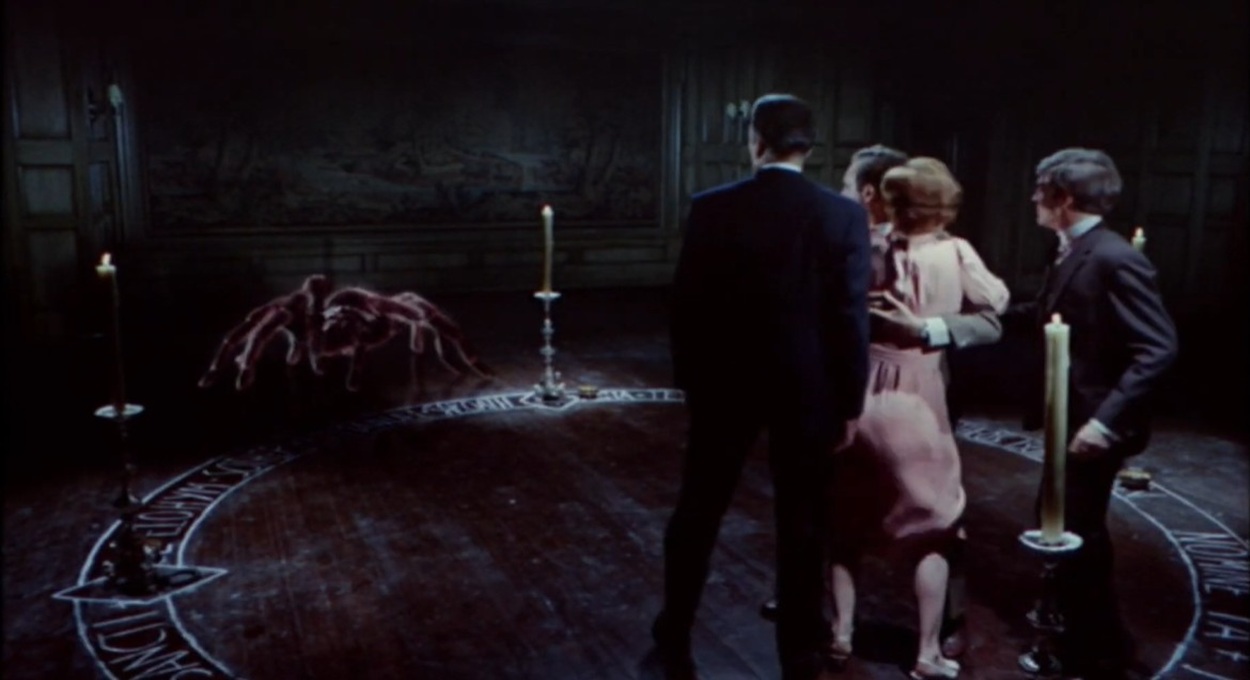
The fight is mental rather than physical, but the action never lets up for a second. In the end, time is reversed through a spell, and our group is returned to safety. Tanith, killed during the earlier events, is restored to life and Peggy is safe at home in her bed.
While the film leans in slightly to Christianity more than the book, it’s de Richelau’s knowledge of occult practices – and Tanith’s – that saves the group more than an Abrahamic deity.
Although critics of the day gave the film high marks for its serious tone and fast pace, The Devil Rides Out didn’t do well at the Box Office, recouping less than half of its production and marketing costs, and so The Duke and his cohorts never got to return in another Wheatley/Hammer adventure. Like all great films, it took a few years for the film to find its audience on TV and home video and by then it was much too late to launch a Wheatley film series as Hammer had originally intended.
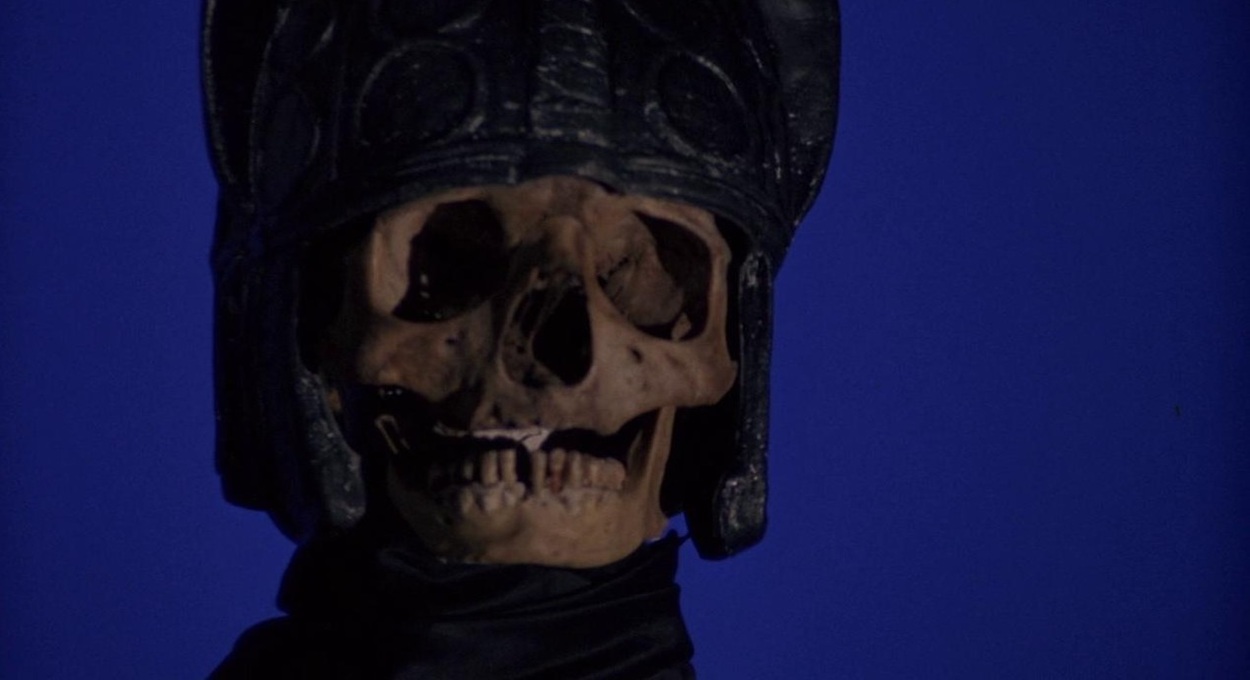
The only other attempt made by the studio to tackle a Wheatley novel – To The Devil A Daughter (1976) – was an utter mess, woefully miscast with only a few memorable moments.
Those seeking to explore more Wheatley should start by listening to The Devil Rides Out audiobook read by Sir Christopher Lee, available in several parts on YouTube.
Despite rumors, Lee, who owned a first edition copy of The Devil Rides Out signed to him by Wheatley and was a key player in the film being greenlit, never personally explored The Left Hand Path. “Never, never, never.” He said. “You will not only lose your mind. You’ll lose your soul.”
 Horror And Sons