
Now that this year’s Halloween Horrors series is entering its final days, I’m going to admit something about today’s particular theme, “Scores & Soundtracks”, that I maybe shouldn’t admit at all. I honestly had little interest in the “soundtracks” half of this theme, really wanting to only focus on original scores composed specifically for their given film. While I have purchased my share of them over the years, I really didn’t want an article focusing on some “alt-rock/nu-metal”, multi-platinum selling soundtrack to a film from the late-1990s/early-2000’s that’s generally better remembered and more celebrated than the film itself.
Thankfully (at least, for me), today’s contributor shared something of a similar belief and presented us these thoughts on what is widely considered by many to be one of the (if not the) most memorable scores in Italian (if not all) horror cinema history. If nothing else, it immediately grabs your attention and lets you know that you’re now entering dangerous territory.
A.C Nicholas first joined our series last year, kicking off events with a look at 1964’s The Creeping Terror. While he was a pretty busy guy at that time, he seems to be the definition of “ubiquitous” these days, appearing on multiple podcasts, livestreams, and contributing to other sites far more reputable than this one. You can find those linked in the intro to this piece, which A.C. wrote himself. Honestly, I’m pretty thankful for that as well as I’m sure that I would have forgotten something.

Zombie (1979)
By
A.C. Nicholas
ABOUT THE AUTHOR: Exploitation-film historian A.C. Nicholas, who has a sketchy background and hails from parts unknown in Western Pennsylvania, was once a drive-in theater projectionist and disk jockey. In addition to being a writer, editor, podcaster, voice-over artist, actor, and stand-up comedian, he currently programs a monthly film series, A.C. Nicholas’s Hidden Gems, at the Babylon Kino in Columbia, South Carolina. He’s a regular guest co-host on the streaming Drive-In Asylum Double Feature, has made multiple appearances on Making Tarantino: The Podcast, and is a new panelist on the Deep Images podcast. He contributes to the Drive-In Asylum fanzine, the B & S About Movies website and podcast, and the Horror and Sons website. His most recent essay, “Jay Ward, J-Men, Dynaman, and the Comedy Re-Dub,” will appear in an upcoming issue of Drive-In Asylum.
As we hear tribal drums in the distance, the film begins. A revolver points directly at the camera. A shrouded body on a bed rises, as it returns from the dead. A single gunshot rings out, resulting in a bloody head wound. A zombie has been neutralized. The wind blows. An indistinct figure stands motionless in the shadows. He intones to someone out of frame, “The boat can leave now. Tell the crew.” Then, suddenly, it’s thump, thump, thump as the score kicks in, with scratchy synthesizers soaring over a syncopated drum-machine track, as the credits arrive. For my money, this is one of the greatest opening scenes of any movie from any genre ever. It fills the viewer with mystery and dread, foreshadowing the horrors that will unfold. This is Lucio Fulci’s Zombie.

As Fulci brilliantly demonstrates in that opening scene, the mating of visuals to music can be transcendent. Think of how many horror movies, even stone-cold masterpieces, wouldn’t be as effective without their iconic scores by Bernard Hermann, John Williams, Ennio Morricone, Howard Shore, Wendy Carlos, Jerry Goldsmith, Tangerine Dream, Riz Ortolani, Goblin, and, of course, John Carpenter. In that list of notable composers, we must also include Fabio Frizzi.
While Zombie a/k/a Zombi 2 a/k/a Zombie Flesh Eaters may have been intended as the Italian film industry’s attempt to cash in on the worldwide success of George A. Romero’s Dawn of the Dead (titled Zombi in some territories), it turned out to be so much more. Fulci, a master director in many genres, but especially horror, created a masterwork of zombie horror from a crazy quilt of elements: a solid screenplay by Elisa Briganti and Dardano Sacchetti, which returned zombies to the Caribbean; Ian McCullough, the stolid hero of many Italian films; Theresa Magdalena “Tisa” Farrow, Mia’s baby sister, whose short film career included the notorious Antropophagus (1980); Richard Johnson, a renowned Shakespearian actor and womanizing wild man, whose horror-film career extended from The Haunting (1963) through Island of the Fishmen (1979) and The Great Alligator River (1979); and lots of eye-popping gore and nudity. But apart from Fulci’s assured direction, no element is stronger than the musical score by Maestro Fabio Frizzi.
Frizzi had only been scoring films for a few years before hooking up with Fulci in what would turn out to be a relationship as simpatico as Alfred Hitchcock and Bernard Hermann, Argento and Goblin, and Michale Mann and Tangerine Dream. The Italian composer would go on to score nine more films for Fulci, as well as Sergio Martino, Bruno Corbucci, Enzo Castellari, and Lamberto Bava. In a 2019 Rolling Stone article on the 35 greatest horror soundtracks of all-time, as determined by a panel of record producers and musicians, he has two entries: The Beyond at #11 and Zombie at #34. That puts him in good company with Tangerine Dream, Wendy Carlos, and Ennio Morricone with two films each. Only John Carpenter has three, including, of course, Halloween at #1. While that poll puts Frizzi’s music for The Beyond, also great, above Zombie, I prefer his work on Zombie, which is in my personal top ten. Here’s why.
I recently met John Valley, the writer-director of the micro-budget, but mega-inventive, The Pizzagate Massacre (2020). He’s an amazing Texas filmmaker, well-versed in classic horror, who is poised to break out as the next Wes Craven with his upcoming film American Dollhouse (2026). Over drinks, we got to talking about music in horror films. When I mentioned Fulci and Frizzi, he immediately said, “Thump, thump, thump” and began humming the theme from Zombie. We both laughed and marveled at how memorable the score is. It’s a product of its era, electronic and spare, but that minimalism is its strength. Like the best scores, it’s magnificent, yet it doesn’t take you out of the film’s universe. Some scores, like Alex North’s Oscar-nominated one for Dragonslayer (1981), are terrific, but you wind up paying more attention to the music than the film itself even if that film is good. Frizzi’s music for Zombie is indeed transcendent and complements everything you see. I can’t give it any higher praise. It’s one for the ages.

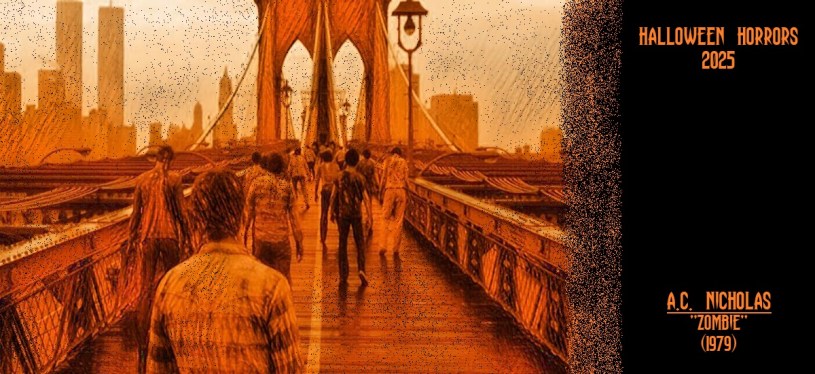
As it began, Zombie ends with another iconic scene, as Lucio Fulci’s zombies shamble across the bridge into New York City to the reprise of Fabio Frizzi’s theme. The zombie apocalypse has begun. While the heydays of the Italian zombie film are long gone, the film and its epic score will live on forever. Bravo and grazie, Maestro.
 Horror And Sons