
Before ever announcing any of the possible themes for this year’s Halloween Horrors series, I asked friends and family (many of whom are contributors to this series) what topics they would like to read and/or write about. Somewhat surprisingly, at least to me, the most popular and requested answer was cryptids and films involving cryptids. For those who may somehow not be aware, a cryptid, as defined by Merriam-Webster, is “an animal, such as Sasquatch or the Loch Ness Monster that has been claimed to exist but never proven to exist.”
As such, there was no way I was going to deny this request. I just wasn’t going to allow everyone to have the opportunity. Again, dirty bastard. That said, I also wasn’t sure that it was the best option as it didn’t offer quite enough variety. When all was said and done, cryptids wasn’t even one of the first five topics claimed by our contributors. I think it may have been ninth, which is somewhat coincidental as this is the ninth entry in this year’s series.
Today’s post comes to us from our dear friend Brian Schuck, creator and guru behind the film critique site Films From Beyond the Time Barrier. Besides being a generally good guy, Brian has become something of an inspiration and motivator, not only encouraging and supporting me in regard to this series these last few years, but also happily welcoming me to his own series and blogathons each year as well. Not only has this introduced me to other great writers and film fans that I may not have otherwise discovered, but also frequently motivated me to get off my ass and write when I get carried away doing anything but.
I also want to give a quick congratulations as Films From Beyond the Time Barrier will be celebrating its 15th anniversary this November. As someone who has more than occasionally walked away from their own site and even considered calling it “quits” completely, I have nothing but respect for Brian’s dedication to not only his site, but also to his passion. I said before that running a blog and or website was the work of a crazy person. At 15 years, Brian clearly is crazier than I. Kudos, my friend.
Are we there Yeti?: The Snow Creature (1954)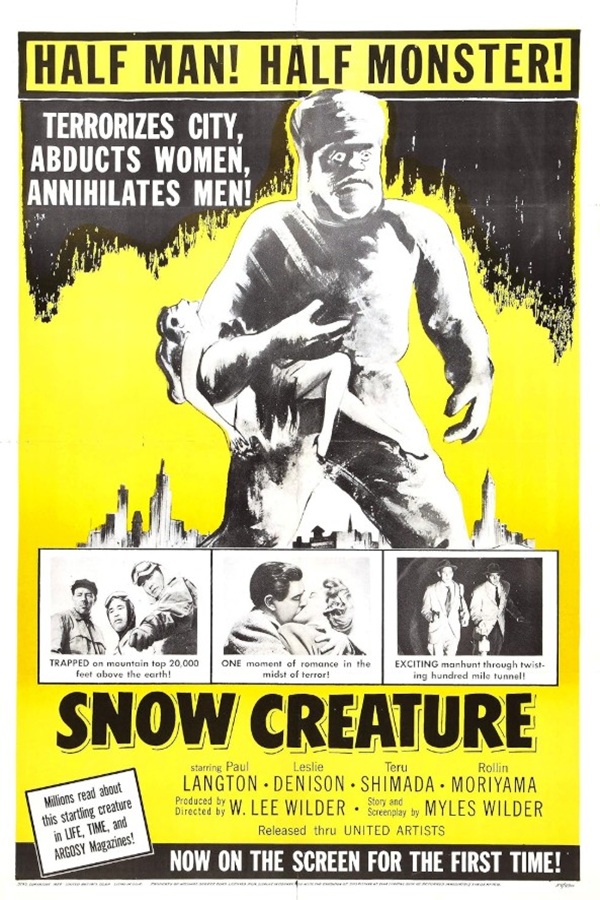
(For Horror and Sons’ Halloween Horrors 2025)
Starring Paul Langton, Leslie Denison, Teru Shimada and William Phipps
Written by Myles Wilder
Produced and directed by W. Lee Wilder
Distributed by United Artists
When I hopped onto the Horror and Sons Halloween Horrors 2025 bandwagon and learned that I’d gotten my first choice of theme, “Hidden Horrors,” I was pleased. When I further learned that the underlying theme was “Cryptids,” I was VERY pleased.
Ever since I devoured Frank Edwards’ “Stranger than Science” books as a kid, I’ve had a soft spot for all kinds of paranormal subjects: UFOs, ghosts, inexplicable disappearances, and of course, cryptids.
Over the years, Bigfoot in particular has become a frequent and welcome guest at my house. My wife and I want to believe. We’ve watched dozens of bigfoot movies, and read dozens more books and articles about “The Big Guy”. We both saw the 1972 microbudget docudrama about a bigfoot-type creature, The Legend of Boggy Creek, and were creeped out in a big way.
But here’s the thing – Bigfoot was not the preeminent bipedal, humanoid cryptid when I was growing up. At least in my neck of the woods, that honor went to the Abominable Snowman (or Yeti as he’s known in more fashionable circles).
Long before Bigfoot started taking big strides across movies, TV and every kind of merchandising item you can think of, his cousin the Yeti was invading the nightmares of Monster Kids and making it fashionable to wear white fur after Labor Day.
My first recollection of seeing a cryptid depiction was watching Hammer’s The Abominable Snowman on a local creature feature. The 1958 film, starring Peter Cushing as a kindly botanist and Forrest Tucker as a brash American entrepreneur, is distinguished by showing the Yetis as a gentle, intelligent species who only resort to violence in self defense, and some of the humans as monsters in disguise.
Then there was Rankin-Bass’ animated holiday special Rudolph the Red-nosed Reindeer, which in 1964 introduced Bumble the abominable snow monster to giddy American kids, and has been raising Yeti awareness over the holidays ever since.
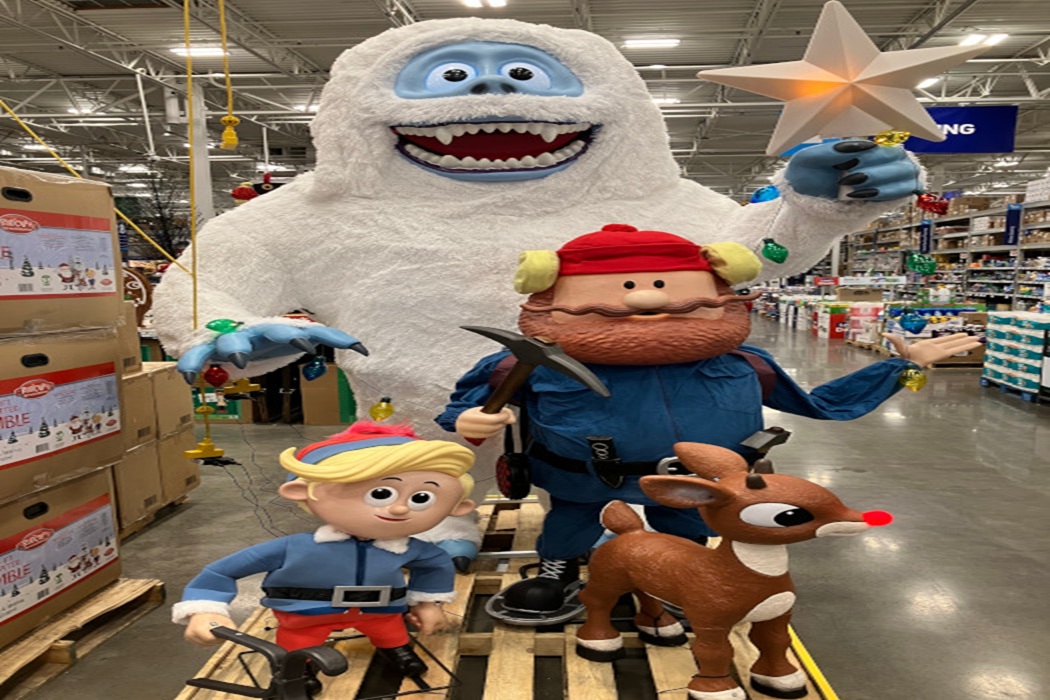
Somewhere in the late ‘70s and early ‘80s, Bigfoot emerged from his hidey-hole and made his run for media fame and fortune to the point that he’s now everywhere you want him to be. But before that, he managed to keep a low profile.
If you do an advanced keyword search in IMDb for “bigfoot” limited to the period 1950 – 1970, the handful of results return mostly movies and TV featuring Yetis, not the classic Bigfoot as we know and love him.
One of those misleading search hits is The Snow Creature, a low budget B-picture about the capture of a Yeti, released by United Artists in 1954. The Snow Creature is credited with being the first American film to depict the abominable snowman, but worldwide, a Finnish comedy, Pekka ja Pätkä lumimiehen jäljillä (1954), apparently has the bragging rights of being the very first.
While Snow Creature is no classic, at least it made a small step toward popularizing a subject that up to then had been confined to pulp magazines and the occasional news story. The film tells a simple tale: Man meets Yeti, man loses Yeti, man finds Yeti in the storm drains of Los Angeles, where it is moving around undetected.
The film opens with botanist and voiceover narrator Dr. Frank Parrish (Paul Langton) readying an expedition to study plant life (such as it is) in the Himalayas. In addition to rounding up the standard complement of locals and head Sherpa (Subra, played by Teru Shimada), Parrish has enlisted an English photographer, Peter Wells (Leslie Denison) to help document the findings.
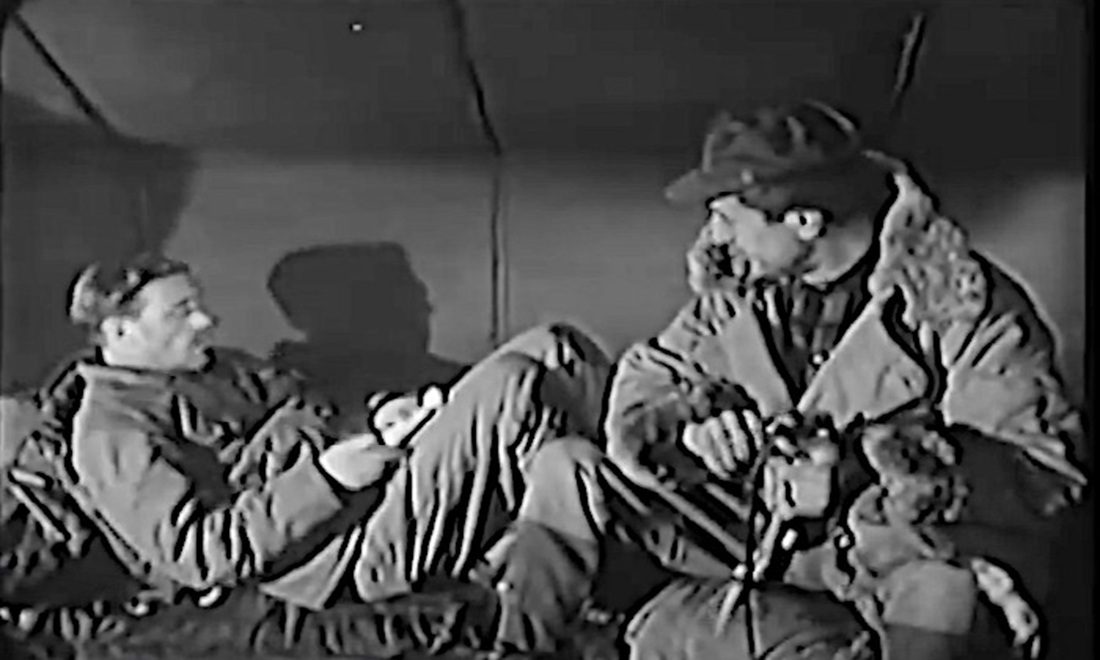
Parrish is all business and kind of a killjoy, and Wells is… well, in addition to all the other supplies and equipment, he’s brought along a case of Scotch, because, why not? He sure as hell doesn’t have to lug it himself, and looking for plant life on frozen mountainsides is cold, thirsty work. On the other hand, Parrish admonishes him not to drink in front of the locals – bad for morale you know!
Morale plummets anyway when, in mid-expedition, Subra learns that his wife has been abducted from their home down in the lowlands by a Yeti on a midnight stroll. Subra is adamant that they have to drop everything and track the Yeti to rescue his wife, but Parrish, who is skeptical to the core, will have none of it.
Desperate, Subra steals Parrish’s and Wells’ rifle ammo while they’re sleeping. Without the rifle as a dispute resolver, the two can only helplessly look on as the Sherpa turns the expedition into a hunting party.
Parrish, the ultimate scientific drudge, seems to lack any sense of wonder or compassion for Subra, and gripes about getting back to his plants even as it becomes clear that the Yeti does indeed exist. Morale takes another hit when the Yeti conducts a surprise nighttime raid on the camp and kills one of the men.
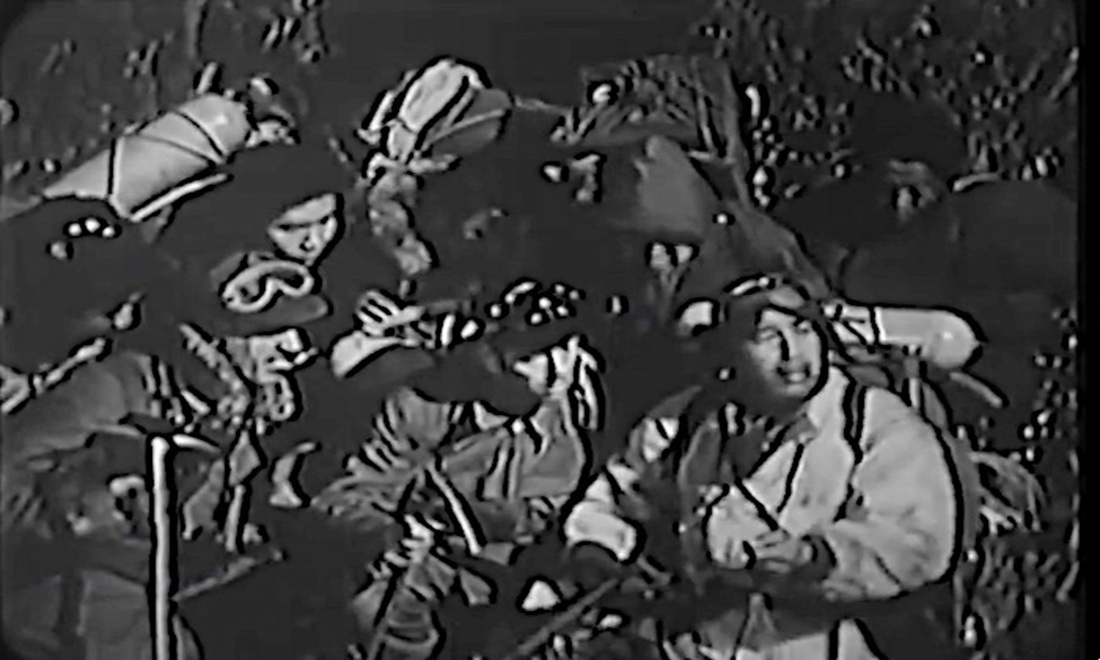
Undeterred, the men continue to track the creature, which resorts to causing an avalanche in an attempt to escape. After the hunting party takes shelter in a large cave, Subra is excited to find his wife’s necklace on the cave floor. Before you can say “abominable,” the men spot the Yeti with his family — a missus Yeti and a toddler. In a rage, the Yeti tries to hurl rocks at his tormenters, but only succeeds in bringing boulders down on his family and himself.
But, Eureka!, Wells got a picture of the cryptid family before the cave fell in, and the male Yeti is only stunned. Subra wants to kill the thing that carried off his wife, but Parrish stops him. The hunting party haul their prize back to civilization, where the local authorities are surprisingly accommodating in an “aw shucks, since you found him, I guess he’s all yours” sort of way.
Wells wants to sell his picture and the Yeti to the highest bidders, but Parrish insists that the Yeti be delivered to his employers at the scientific foundation. He orders a special refrigeration unit to transport the creature back to the States in chilly comfort. But stateside, the bureaucrats are not nearly as accommodating. They want to know if the thing is human or animal before allowing it into the good ol’ US of A, and in a head-scratching development, they hire an anthropologist to make the call. In the meantime, the creature has to bide his time in an LA warehouse.

That “meantime” is just enough time for the disgruntled snowman to start banging on the sides of the unit, whereupon he tips it over, breaks out, and attacks a security guard before hightailing it into the night (if this refrigeration unit is rockin’, don’t come a knockin’!)
Reports of snowman sightings and attacks (not to mention deaths) start coming in, and Parrish teams up with chief investigating officer Lt. Dunbar (William Phipps) to once again track the wayward creature. The reports suggest that the creature is ranging far and wide through the city streets, yet it’s getting around undetected by the scores of police units on alert. It can’t fly and it’s not invisible, so how?
Then, from Dunbar’s office window, Phipps’ gaze rests upon a large opening to the sewer system. Hmmmm…. Will Phipps and Dunbar be able to track the thing through the dark and the muck of LA’s sewers and capture it before it kills again?
Amazingly, the low rent Snow Creature is related to Hollywood royalty… sort of. The film’s producer-director W. Lee Wilder and its writer, Myles, were brother and nephew respectively to multiple Oscar winner and legendary writer-director Billy Wilder (Stalag 17, Some Like it Hot).
Born in Poland and long estranged from his famous brother, W. Lee started out making purses and handbags before trying his own hand at the movie business, producing and directing a string of B thrillers and sci-fi flicks, mainly in the ‘50s.
While certainly not classics of the era — the low budgets are obvious in every frame — Wilder the Lesser’s sci-fi films in particular display a sort of naive earnestness that has gained them a small cult following. (Although, brother Billy was apparently not a fan. IMDb quotes him as jokingly describing his brother as “a dull son of a bitch.” Ouch!)
Myles’ earliest film writing credits were for his dad’s low budget potboilers. Of that group, the sci-fi flicks — Phantom from Space (1953), Killers from Space (1954) and The Snow Creature — are the ones that have most consistently appeared over the years on broadcast TV, on DVD, and even today on streaming platforms (Killers is particularly memorable, featuring the most ridiculous pop-eyed aliens ever committed to film.)
Myles would go on to write for every conceivable genre of TV show from the ‘60s through the ‘80s, reaching the zenith of his art by producing and writing dozens of episodes for The Dukes of Hazard.
The Snow Creature’s reputation as the first American Abominable Snowman movie has not prevented criticism of its idiosyncratic dramatic choices and slow pacing.
Indeed, there are many, many scenes of people talking on and on in static medium shots with little intercutting to make things more lively. (One egregious example comes when Parrish explains to a security officer in great detail the controls of the Yeti’s refrigeration unit.)
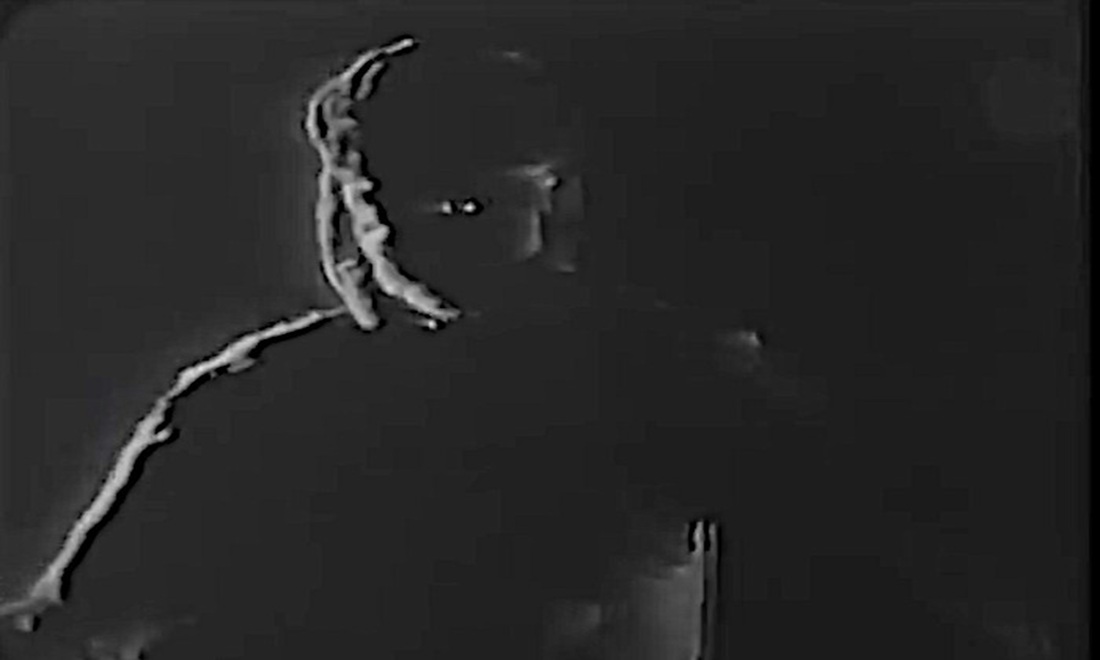
Planes take off, planes land. The hunting party takes an eternity (cinematically speaking) trudging around in the mountain snow. Shots are reused, some of them multiple times. One in particular, of the head and shoulders of the snowman obscured by shadows, is used multiple times to show the creature advancing menacingly, and in reverse, retreating into the night.
Sometimes an indifferently directed cheapie larded with stock and reused footage can be saved by an energetic lead or second banana, but Paul Langton as “Parrish” is stolid and unimaginative to the point of unintentional comedy. A real head slapper comes when, after capturing the Yeti, he muses something to the effect that at least it’s compensation for having failed with the botany part of the expedition. Steady now Dr. Parrish, don’t get too excited!
Pasty/baby-faced William Phipps as “Lt. Dunbar” doesn’t add any significant energy, but, during the urban hunt for the escaped Yeti, his face does light up when he confides to Parrish that his wife is expecting.
British actor Leslie Denison as bad boy photographer “Wells” does provide potential, and you can’t help but like a character who is comfortable enough with himself to bring along a case of his favorite Scotch on a remote expedition.
And, unlike his boss, he at least seems to have some appreciation of the enormity of the find, even if it’s to greedily cash in on the creature. But once things shift stateside, Wells is brushed off and disappears from the rest of the film.
That being said, I don’t want to leave the impression that I dislike The Snow Creature. It is, after all, one of the first film depictions of a favorite cryptid, one that is especially mysterious and intriguing due to its supposed habitat in one of the most extreme environments on earth.
Wilder makes a wise choice to keep the creature to the shadows and long shots and let the audience fill in the details with their imaginations (you can see just enough to conclude that showing any details of the suit would not work well).
Plus, the reveal of the Yeti family in the cave scene lends the creature a smidgeon of empathy and saves him from being just another “ravening monster killing for the heck of it.”
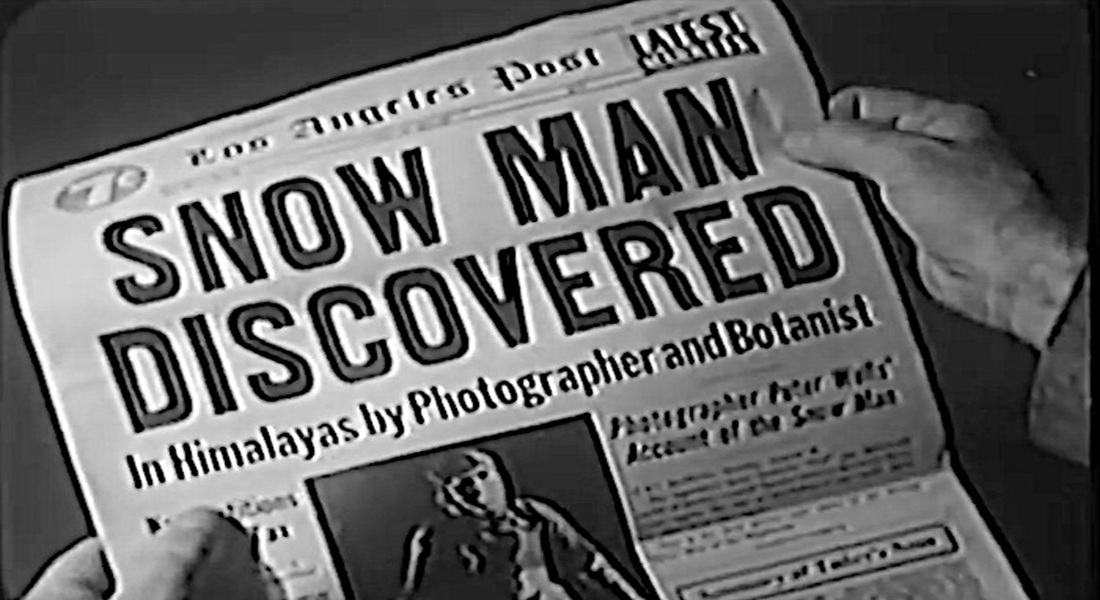
Things pick up once the escaped snowman starts roaming the city streets at night. These scenes are dark and moody and reasonably suspenseful.
One effective scene takes place in a darkened meat packing plant, when two employees are startled by the hungry Yeti, who presumably can’t believe his luck to have stumbled on so much beef on the hook. In a closeup, we see just the creature’s arm and clawed hand clutching the side of beef, then the camera pans up to reveal a horrible, grimacing face, half in shadow.
Cinematographer Floyd Crosby makes very effective use of light and shadow in the LA location shooting. In one jarring scene, just a woman’s legs — a victim of the Yeti — are visible under a street lamp.
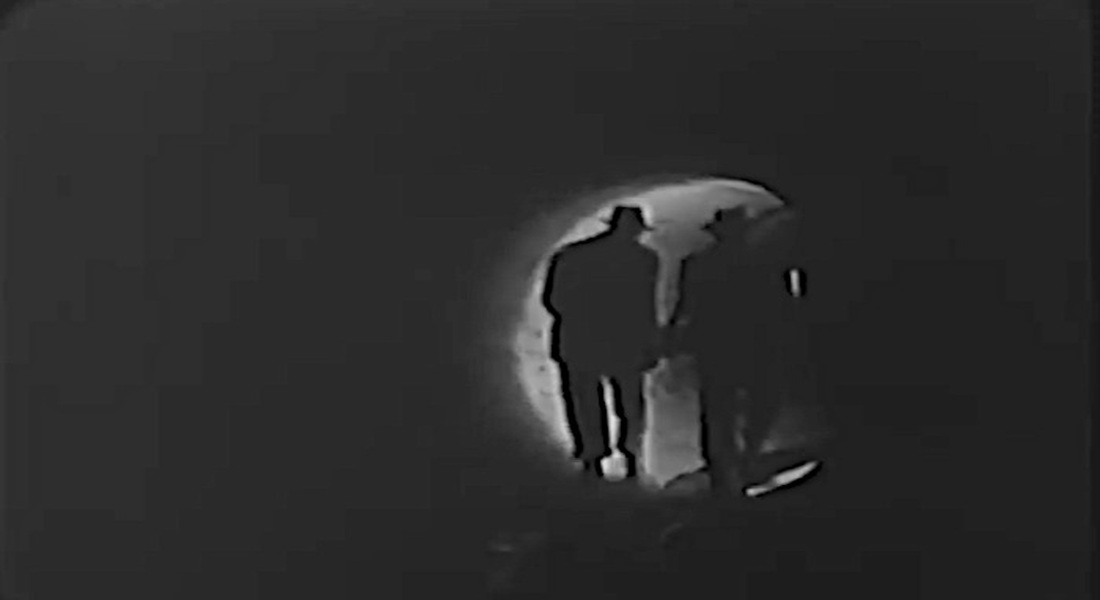
In another set in LA’s dank, dark sewer tunnels, the silhouettes of two policemen on the hunt are framed by a circle of light which seems to get smaller, threatening to swallow them up as they walk slowly away from the camera. These and similar nighttime shots make this cryptid movie a very suitable Halloween season watch.
On the other hand, if you’re in an MST3K or RiffTrax frame of mind, The Snow Creature has all kinds of possibilities. Try a drinking game where you take a chug whenever a shot is reused, or a character says something casually inappropriate considering the circumstances. If you’re not at home, just be sure to have a designated driver or a couch to sleep on.
 Horror And Sons