
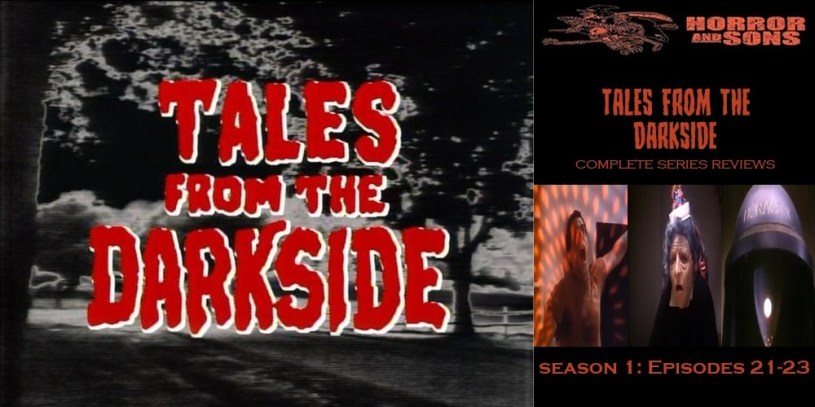
Season 1, Episode 21: “Bigalow’s Last Smoke” – Original Airdate: June 9th, 1985
Directed by Timna Ranon (who also directed the dreadful “Mookie and Pookie” episode from earlier in the show’s first season)
Teleplay by Michael McDowell, based on a story by Ken Hanis and Craig Mitchell (writer of 1998’s Milo and co-writer of 1999’s Komodo)
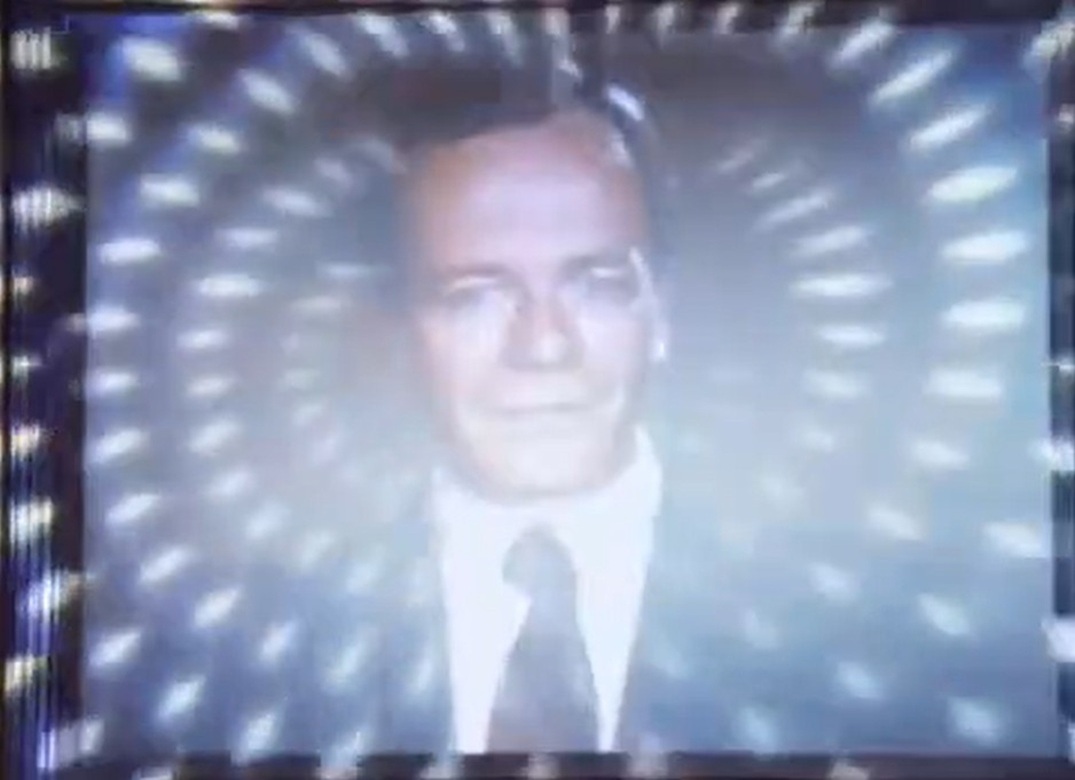
The titular Bigalow (Richard Romanus – Mean Streets, Andy Milligan’s The Ghastly Ones) awakens to find himself in what he initially believes to be his small studio apartment, but soon discovers to be merely a replica or facsimile, here referred to as a “simulacrum”. The image of a man’s face appears on the screen of the apartment’s television. The man introduces himself as a Dr. Synapsis (Sam Anderson – Critters 2: The Main Course, TV’s “Perfect Strangers”), and calmly reminds Bigalow that he recently (and somewhat unknowingly) signed himself up for a new treatment to help quit his three-pack-a-day addiction to smoking. That treatment will be taking place within the walls of this simulacrum.

“Within the walls” is the central idea to this concept as, unlike his real apartment, Bigalow has no means of escape. There is neither phone nor radio, and the television has no reception outside of the frequent “check-ins” from Synapsis. There is little for him to bide his time with… other than lighting up another cigarette, of which he still has quite a few. However, as Bigalow quickly and repeatedly learns, doing so activates an extremely loud smoke detector set high on the apartment’s ceiling, as well as a barrage of somewhat psychedelic lighting.
Things progress slowly for Bigalow, succumbing more to habit than any real urge to smoke. He tries to ignore the alarms and lights, but they seemingly increase in magnitude, becoming more than he can bear and he butts out each cigarette before he can finish it. Soon, Bigalow hears a friendly voice through a small hole in the apartment’s wall. The voice claims not only to be another of Synapsis’ patients, but also to know how to silence the dreaded alarm. However, he is only willing to share this information at the steep price of Bigalow’s last remaining cigarettes. Bigelow reluctantly pays the price… twice; once by giving up his smokes, and again when he discovers that he has been deceived; presumably another step in his “treatment”.

As somewhat alluded to by the episode’s title, “Bigalow’s Last Smoke” concludes with Bigalow seemingly having kicked his habit. As this is Tales from the Darkside, while he may be free from his addiction to smoking, he soon learns that he is not yet free to leave.
Overall, the episode is fairly satisfying and Romanus gives a pretty solid performance. That said, I’ve always found certain aspects of the episode to be quite odd, and not just for the bizarre distortion of reality involving the size of the smoke alarm and the height of the apartment during one of Bigalow’s final relapses. While I readily admit that the sound of the alarm is irritating enough to have made me want to quit smoking*, I’ve never really understood the purpose or effect of the lights. Also, the treatment seems overly elaborate, so I’d really hate to see the bill.
*Yeah, that’s not one bit true. I was a smoker for 25 years and found myself regularly facing multiple things far more infuriating than an alarm, none of which ultimately played a role in my finally quitting. Hell… if anything, those things made me want to smoke more.
Season 1, Episode 22: “Grandma’s Last Wish” – Original Airdate: June 16th, 1985
Directed by Warner Shook (“Richard Grantham” in the “Father’s Day” segment of Creepshow)
Written by Jule Selbo
An elderly woman with significant hearing loss and some probable signs of dementia, we’ll refer to her as “Grandma” (Jane Connell, who appeared on multiple episodes of “Bewitched”, but is probably best known as a Broadway performer), lives out her remaining days with her son, his wife, and their teenaged daughter, Greta (Kelly Wolf – Graveyard Shift, Less Than Zero). Although the old woman’s presence is more akin to a nuisance or inconvenience than a true burden, her family longs for nothing more than to get her out of their house and out of their hair. To be fair, her family are obnoxious, self-centered, loudmouth automatons, mindlessly consumed with the more trivial aspects of their little lives. As such, they schedule a visit from a representative for a nursing home… I mean, “retirement community”, in the hopes of enticing Grandma to finally move out. Gregory Itzen of the television series “24”appears as the rep.
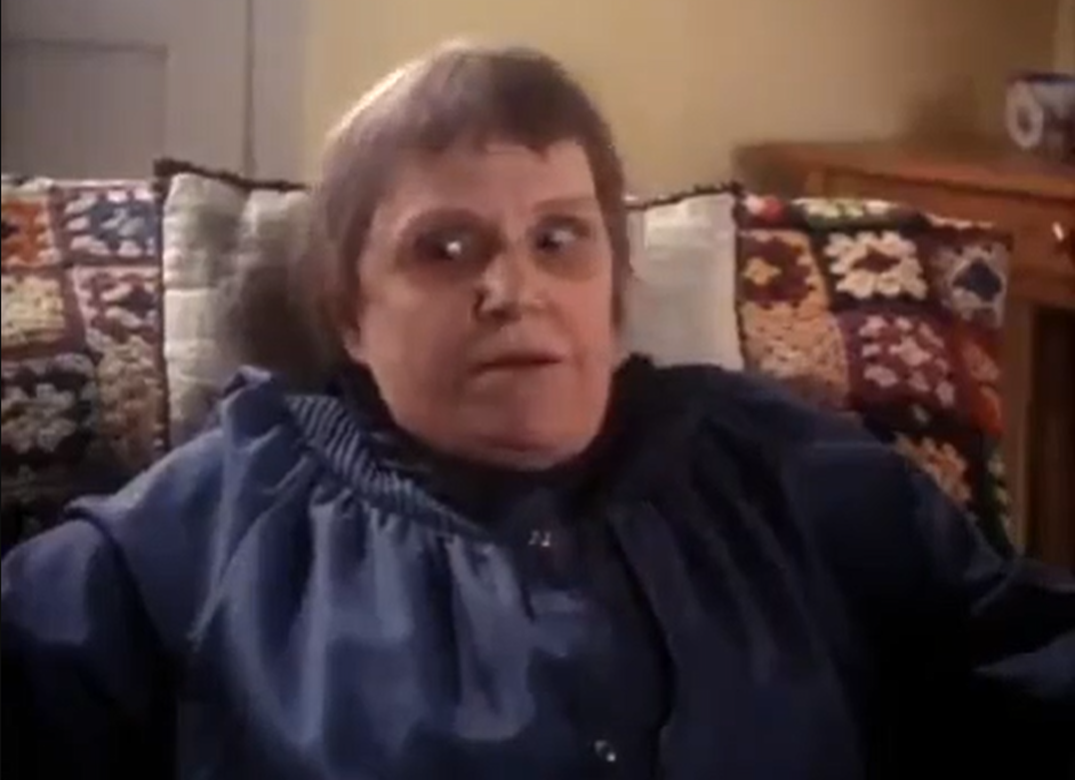
Grandma is terrified by the idea of leaving the family that she (and possibly only she) loves, yet hurt by thoughts of having become a burden and essentially being sent away to die alone. She reluctantly signs the agreement to move, but not before the entire family offer to spend their last week together attempting to fulfill one last wish for the old bag their beloved Grandma. Grandma makes that wish, but doesn’t bother to share that information with anyone, the viewer included.
During this final week together, a series of bizarre accidents and ailments befall Grandma’s family. These begin with things such as muscle pains and cases of forgetfulness, but escalate until just moments before the gentleman from the retirement community arrives to retrieve Grandma for the trip to her new home. When he does arrive, he’s aghast at what he discovers waiting for him in the family’s dining room. Although never explicitly stated, it’s now quite evident that Grandma’s final wish not only taught her family to be a little more sympathetic to her situation, but also found a way for Grandma to keep them all together.

If I’d ever watched “Grandma’s Last Wish” at any point prior to viewing it for this review, I had completely forgotten about it. Although I have stated previously that I tend to prefer the darker, more “traditional” horror episodes of Tales, I did find “Grandma’s Last Wish” to be a mostly entertaining episode. If the goal of the performances was to make each character as annoying, unamicable, and generally unworthy of much empathy, then I would say that each of the cast gives a stellar performance. However, this is also something of a hinderance as I generally did not care what misfortunes awaited any of them, Grandma included.
MORE ON SELBO: Selbo would go on to write for television shows such as “Monsters”, “Life Goes On”, “The Adventures of Young Indiana Jones”, and “Melrose Place”, as well as straight-to-video film sequels for Disney.

Season 1, Episode 23: “The False Prophet” – Original Airdate: August 4, 1985
Directed by Jerry Cotts
Written by Larry Fulton and Jule Selbo

A Nightmare on Elm Street‘s Ronee Blakley stars as “Cassie”, a woman so obsessed with superstition, astrology, tarot, and modern-day (circa mid-1980s) “new age” spiritualism that she places all her faith in a computerized fortune teller called “Madame X”, allowing the device to make all of her major life decisions. Following one of Madame X’s fortunes, Cassie takes a bus heading to Lubbock, Texas, but is forced to make a layover in a small diner located somewhere in Oklahoma. Cassie informs the older woman working the counter (and, really, the world at large) the reasons and motivation behind her trip. The older woman replies that her husband has recently purchased a similar machine for use in the diner. Named “Horace X”, the machine is purported to be an updated version of the Madame X; the “son” of Madame X, as Cassie refers to it.
Cassie is compelled to test out Horace X, but is shocked to hear it say that she need travel no further and warn that danger awaits her if she attempts otherwise. Once more taking the advice of a machine, she skips her transfer, opting to take a later bus… whenever that may be. “Beware of false prophets” proclaims Horace X just mere moments before a preacher (Justin Deas – TV’s “Santa Barbara”, 1986’s Dream Lover) enters the diner’s doors. However, this is not your common bible-thumping preacher, but instead a free-wheeling. womanizing huckster… and potential psychopath, but that’s for a different tale.
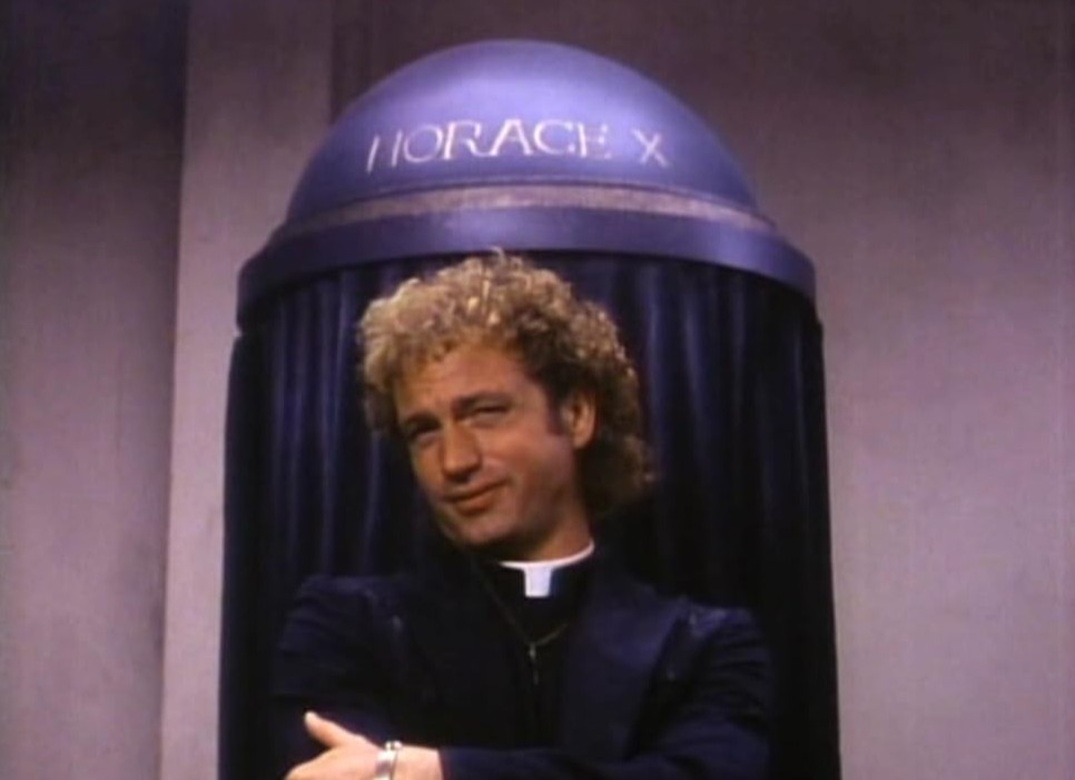
The preacher, one Heat Jones, wastes no time making moves on Cassie, which draws the ire of Horace X. As the man speaks, the machine repeatedly calls him a liar and reminds Cassie not to listen to the man’s words. Not one to compete with an passive-aggressive collection of wires and circuit boards, Heat attempts to destroy the machine, but Horace X seemingly shocks the preacher unconscious. Horace X then reveals to Cassie that it is the love interest that she has travelled so far to meet… before essentially absorbing her soul into its programming. Jones awakes to find ashes in the shape of a human before hearing what sounds like Cassie’s voice calling for help emitting from Horace X’s speaker(s).
Personally, I think “The False Prophet” has a fairly strong concept, but the execution is a little lacking. The build of the Horace X machine is fairly hokey and not at all convincing, especially considering that this was the era of arcades and coin-op video games. Honestly, this thing has less features than a Speak & Spell, and less lights than a Simon memory game. That said, the episode’s biggest detriment is probably the character of “Cassie” herself. While probably too unrelatable for many viewers, the character is also far too oblivious and disconnected from reality. So, while viewers may not necessarily be wishing misfortune on the character, they’ll presumably not be too saddened when it does occur.
DOWN THE RABBIT HOLE: “The False Prophet” was the only directorial effort for Jerry Cotts, who spent most of their career working as a cinematographer. Some of the projects Cotts worked on include The Rolling Stones’ Let’s Spend the Night Together concert film, Pumping Iron, and the 1974 sports documentary/”fluff piece”, O.J. Simpson: Juice on the Loose, which was directed by Tales from the Darkside creator George A. Romero. Maybe not-so-coincidentally, Cotts also worked on the 2015 documentary “The Secret Tapes of the O.J. Case: The Untold Story.”

So, that wraps up the first season of Tales from the Darkside. Personally, I do feel that the show’s first season started exceptionally strong, but short a little steam near its conclusion due to what I consider to be some weaker episodes. Granted, this didn’t seem to actually hurt the series any as a second season would soon be underway, it too featuring its share of highly memorable moments and scares. If anything, these last couple of episodes demonstrated that writer Jule Selbo was quite adapt at creating truly annoying and unlikable characters… which probably served well while working on “Melrose Place”. Maybe the episodes could have been scheduled a little differently to help the season finish a bit stronger and more memorable, but these opinions are purely subjective and offer only one viewpoint.
 Horror And Sons