

When Horror And Sons debuted back in late September of 2014, I had no preconceived notions of what I hoped to accomplish with this site. I didn’t have the slightest clue what I was doing or the proper way to do it. Nearly eleven years later, not much has changed.
As some may recall, the first review ever posted on this site was for the 1982 film Oasis of the Zombies. As I joked about in that review, there was no logic behind picking this specific title. It wasn’t one of my favorite films, nor did it hold any kind of special meaning to me. The only reason that I picked the film was because I hadn’t watched it in a few years and was down to give it another spin, especially as I had recently purchased the film’s blu-ray release from Kino Lorber.
Recently, I’ve taken to rewatching my entire “home media” collection (in no particular order) and it was time to once more watch Oasis of the Zombies. As this would be the first that I had watched the film since writing that initial review over a decade ago, I figured that I could write an “updated” review to see if my opinions had changed over the years. Spoiler: they haven’t.

Produced by French film company Eurociné, Oasis of the Zombies was directed by Spanish filmmaker Jesus “Jess” Franco, sometime after he backed out of directing another zombie film for Eurociné, 1981’s Zombie Lake (directed by Jean Rollin). Now, I won’t pretend to be overly knowledgeable about Franco’s works, especially not to the degree of someone such as my pal, Sam, over at BAndSAboutMovies.com. I’ve seen some of Franco’s films, such as Count Dracula, Mansion of the Living Dead, and A Virgin Among the Living Dead, but had formed little opinion of his works other than what I deemed to be a notable inconsistency.
As the film opens, two young women are cruising in a Jeep through the desert somewhere in Africa. They stop the Jeep near a cluster of date trees* and step out to stretch their legs. In my original review of the film, I felt it of great importance to point out the “Daisy Duke”-like shorts that these women are wearing… and I still do. It’s pretty obvious that Franco felt they were important too based on the amount of time spent having the camera focus on these ladies’ rear ends. It may be more correct to say “zoom-focusing”, which is apparently a common trait of Franco’s.

*I should admit that I only know that these are date trees from a joke that one of the women makes about “needing a date”. However, as Det. Ray Cameron would say, “the good news is your dates are here.” The bad news… well, you know the rest.
The women stumble upon some poorly concealed Nazi weaponry and equipment, presumably left behind from World War II. They don’t get much chance to inspect these antiques before being set upon by zombies, hence the film’s title. It’s quickly revealed that this “oasis” is the burial ground for six million dollars’ worth of stolen Nazi gold! However, the oasis is also rumored to be haunted by the spirits of the soldiers that died fighting over the gold years prior. Needless to say, those rumors were well-founded.
Sometime later, a retired officer with knowledge of the gold’s location is murdered for his secrets. While going through the deceased man’s possessions, his son, Robert (Manuel Gélin), learns of the gold and his father’s involvement in its heist. That said, most of this is relayed via an extended action sequence featuring lots of footage reported to have been lifted from the 1971 Italian war film Heroes Without Glory. Seeking adventure, Robert decides to gather up his friends from college and head out in search of the gold.

As mentioned, the previous flashback sequence carries on for an extended time, covering not only the battle at the oasis, but also Robert’s father’s rescue by the residents of a nearby village. Here, we are introduced to the native girl who will become Robert’s mother, as well as her father, a sheik. The film also spends some time setting up the “legend” of the oasis and its zombies. There’s quite a bit of exposition taking place here, but none of it is all that essential to the plot and comes across feeling like little more than filler. This sequence does feature the film’s first nude scene, which seems to be a prerequisite for many of Franco’s films.
Soon after, and back in the then-present era, a group of treasure hunters (led by the man that killed Robert’s father) find the oasis. Of course, the zombies soon make their appearance. Some of these undead appear to be fairly intact and show surprisingly little rot and deterioration for having been dead 30-plus years, while others are rather worse for wear. It’s also quite impressive that the more decrepit of these zombies are able to beat up and choke out their victims with such brittle, bony hands.

Robert, who has served as more of a secondary character/plot device until this point, and his friends finally resurface, having evidently made their way from London to Africa. Not long after their arrival, they meet another group of Brits whom I believe to be missionaries, although it’s never really said. Circumstances lead Robert to meet his father’s killer (who offers no information on the location of the oasis), as well as the sheik, who personally leads his grandchild to the entrance of the place.
Random Observation: The cremation of a human body seemingly serves as an aphrodisiac for a certain female supporting character as she has sex with one of Robert’s friends immediately afterwards, despite having only exchanged maybe one line of dialog prior. I’m not sure why this minor plot point sticks out to me, but if Franco felt it important enough to include in the film, I guess that makes it important enough for me to mention. Or not.
Robert and crew’s arrival at the oasis brings the film to its final act. Much like the zombies featured throughout the film, things initially move along at a shambling pace and play out fairly predictably, at least as far as who survives and who does not. The final resolution to the situation is fairly unique and not one I recall seeing in any other zombie film. That said, it also feels quite random, abrupt, and not one bit satisfying or befitting.

Characters do tend to just stand around waiting to be eaten when confronted by one zombie, let alone multiple. This aspect is sure to infuriate many viewers. However, if those viewers are anything like me, they may be too confused by how the number of zombies haunting the oasis increases exponentially as the film progresses to care about how these idiots react to their impending demise. Then again, as this “oasis” doesn’t really look like the “oasis” from the film’s opening or prior zombie attack, it may be safe to assume that the whole damned desert is overrun with zombies. Every desert. All of them.
In my original review, I concluded that Oasis of the Zombies was a “bad film”, but one that I inexplicably enjoyed. I called the zombie make-up “lazy” and compared the film’s soundtrack to “someone mashing the buttons of a bottom-end Casio keyboard”. Ten plus years later, my opinion of the film is basically the same. Oasis of the Zombies is not a very well-made film, featuring a paper-thin plot with plenty of “day-for-night” scenes and superfluous stock and second-unit footage to justify its runtime.
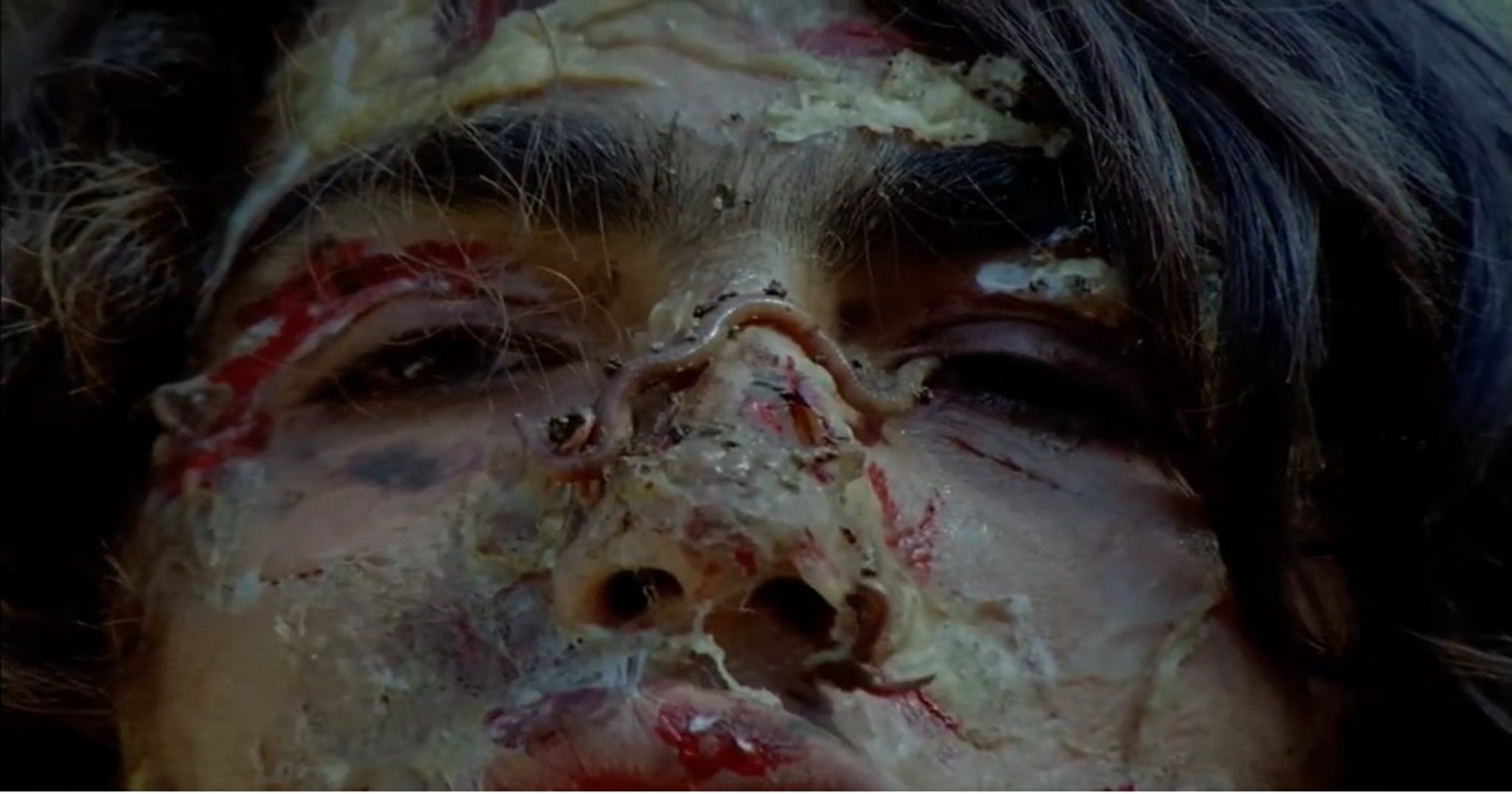
To be fair, zombie make-up is fairly sloppy and often appears to consist of caked-on latex, glued-on tissue paper, live worms, and possibly chicken skins, or a combination of the bunch. There are also a few dummies on display, which occasionally are more convincing than some of the live-actor zombies. (That’s not a compliment.) While nothing here is what I would call “impressive”, what is impressive is that each zombie looks quite different from the next, making each feel somewhat unique… even if they all look fairly silly.
As for that soundtrack? Oasis of the Zombies doesn’t exactly have what I would call an “original” score. Most of the music is comprised of what sounds like an eerie-sounding, synthesized pipe organ which drones over the scenes. Although this could have easily been sourced from the public domain, the music is quite similar to something you might find on one of those old “Spooky Sounds” records from the 1970’s. While this does add to the low-budget nature of the film, the music may be my favorite element of the film, and is something I personally would love to have playing in the background for when trick or treaters stop by on Halloween night… or on a weekend afternoon while I’m doing chores around the house. That’s just how I roll.
There are 2 versions of the Oasis of the Zombies: A French cut, which is the version most commonly released to home video, and a Spanish cut, which allegedly features a little more gore and an appearance from Franco’s regular “muse”, Lina Romay. I can’t say if I’ve ever watched the Spanish cut, but it doesn’t sound as if the differences between the two versions are significant enough to make one superior to the other.

The Kino Lorber blu-ray of Oasis of the Zombies was released way back in February of 2013, and currently stands as the only HD version of the film released in the US. Seeing as how many similarly obscure titles seem to receive updated restorations and scans every few years, it’s somewhat surprising that this film hasn’t seen a newer home video release. As mentioned in my original review for the film, Kino Lorber’s blu-ray release for Oasis was something of a revelation for fans as they could finally see just what happens during the film’s climax as most of the Standard Definition prints found on cheap multi-film DVD collections were so dark as to be nearly unwatchable.
In closing, I refer back to a thought that I presented in my original review for this film: Just how easy is it to find this oasis? The girls from the film’s opening just roll right up to the place with no difficulty or obstruction? What’s to stop anyone else from doing the same? Besides the zombies, obviously. However, zombies seem like something you’d have a hard time keeping secret. News like that tends to get around.
Trailer
 Horror And Sons
I saw this for the first time a couple of years ago, and was definitely amused by some of the characters’ wardrobe choices and their tendencies, like good B movie victims, to blithely wander into harm’s way.
I have seen enough of Franco’s work post Awful Dr. Orloff and Diabolical Dr. Z to marvel at how the maker of those minor masterpieces could put out such drek in the following decades, and become the schlockiest of schlockmeisters.
LikeLike