
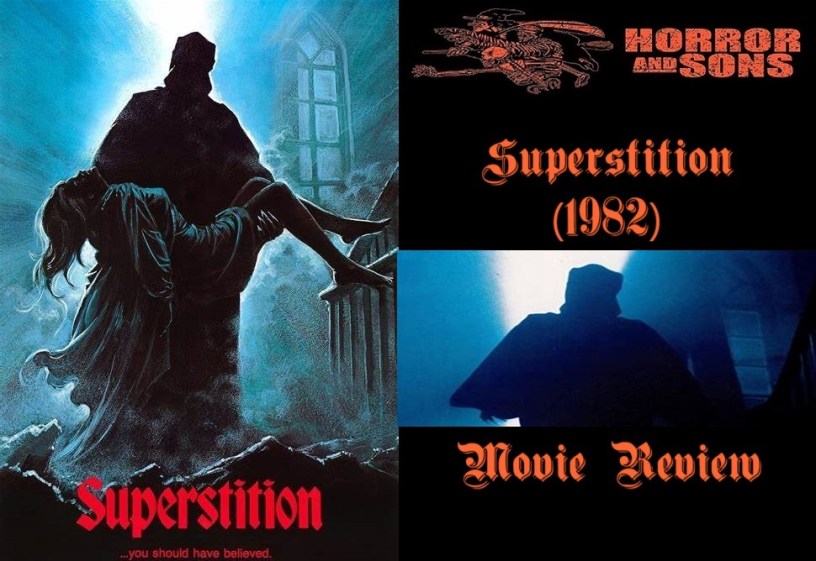
Some time back, I accepted a “bloggers’ challenge” from my friend at Films from Beyond the Time Barrier to write articles highlighting five horror films from the 1980’s that I considered to be underrated or under-appreciated by the general horror fandom community. I started this attempt with a look at the 1982 slasher film, Unhinged. After nearly a year focusing on anything but this website, I’m finally returning to this challenge to speak about another film from the 1980’s that I think deserves a little more love. Let’s get to it.
Superstition is an independently produced 1982 supernatural-themed horror film starring James Houghton, Albert Salmi (Empire of the Ants, Caddyshack), Stacy Keach Sr. (Ants!, The Clone Master), Jacquelyn Hyde (The Dark, 1973’s House of Terror) and Billy Jacoby (the kid in damned near every 1980’s movie). The film was executive produced by Mario Kassar and Andrew Vajna. While Superstition was anything but a box office success (more on that later), the duo of Kassar and Vajna would fare a little better with their next release, the Sylvester Stallone classic, First Blood.
Superstition was directed by James W. Roberson. Roberson had previously served as the cinematographer on films such as 1972’s Rod Serling-narrated Encounter with the Unknown and the 1977 horror-western The Shadow of Chikara, as well as a trio of films for director Charles B. Pierce: Winterhawk, Greyeagle, and The Town That Dreaded Sundown. While Roberson would only direct two other films in his career (1980’s cannibal-western The Legend of Alfred Packer and 1990 family film The Giant of Thunder Mountain), he would turn his talents towards television in the late 1980s’ and has worked quite frequently on shows for Nickelodeon in recent years.
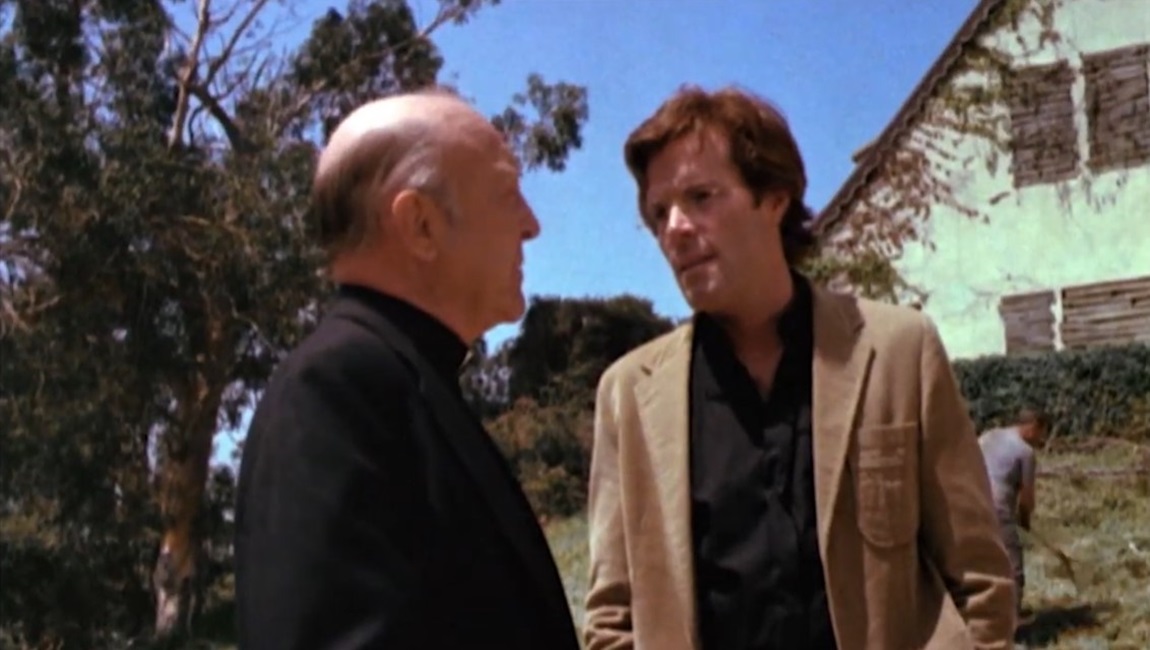
Houghton portrays “Reverend David Thompson”, a young priest recently assigned to a new parish as a replacement for the retiring Reverend Maier (Keach Sr.). One of his first duties is to oversee the clean-up of an abandoned house on the church’s grounds, one that will be used to house another visiting priest, Reverend Leahy (one-time Boston Braves prospect Larry Pennell), and his family. Granted, the house has already been the site of a few unexplained murders, but everyone needs somewhere to call home, right?
ACTOR TRIVIA: Despite appearing in titles such as 1972’s Sweet Sugar, the Beatles-themed 1978 film I Wanna Hold Your Hand, and 1988’s Purple People Eater (opposite a young Neil Patrick Harris), Houghton would shift his focus to writing, contributing to shows such as “Knots Landing”, “Days of Our Lives”, and even “Tales From the Darkside” before becoming one of the head writers for “The Young and The Restless” in the early 1990s.
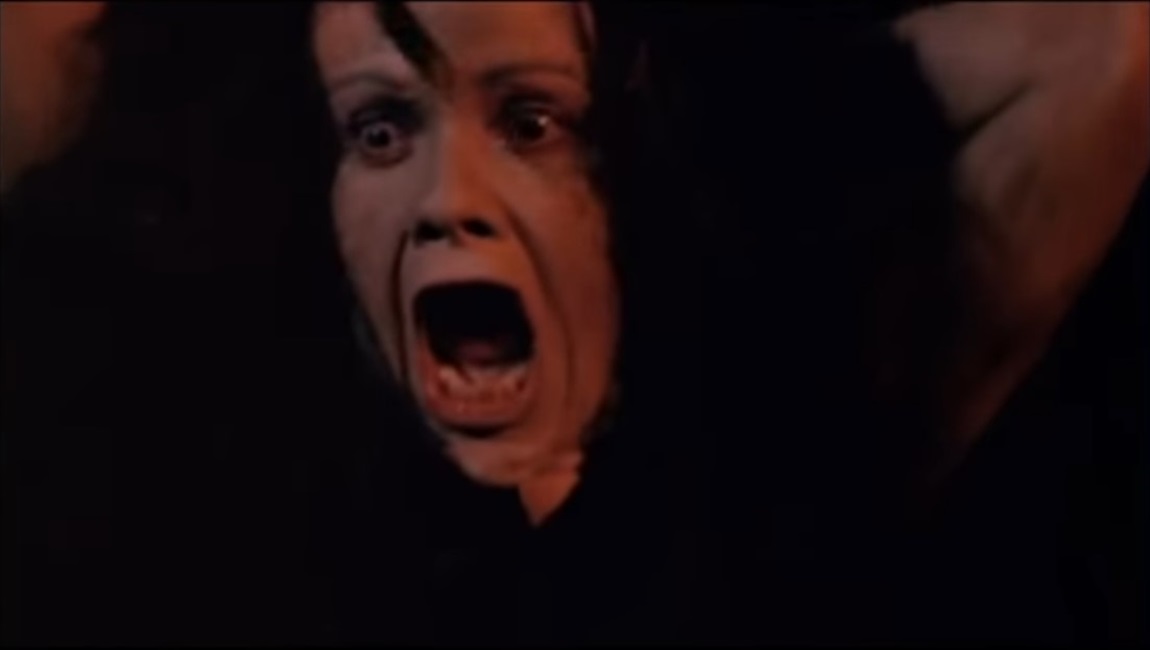
As Superstition was produced during what most consider to be “the Golden Age of slashers”, it’s not overly surprising to discover that the film features more blood and gore than many of the better known “ghost story/haunted house” films of the era. In fact, Superstition wastes little time exploiting its nastier side, showcasing two gruesome deaths in its opening moments. One young man trespassing on the property is bisected by a collapsing window, half his body landing in the house with the other half plopping into the yard, while another young man has his severed head exploded in a microwave. Sure, the prop head used for the effect isn’t very convincing, but having a human face burst open in just the film’s first few minutes is a great way to get an audience’s attention and to let them know early just what kind of cinematic experience they are in store for.
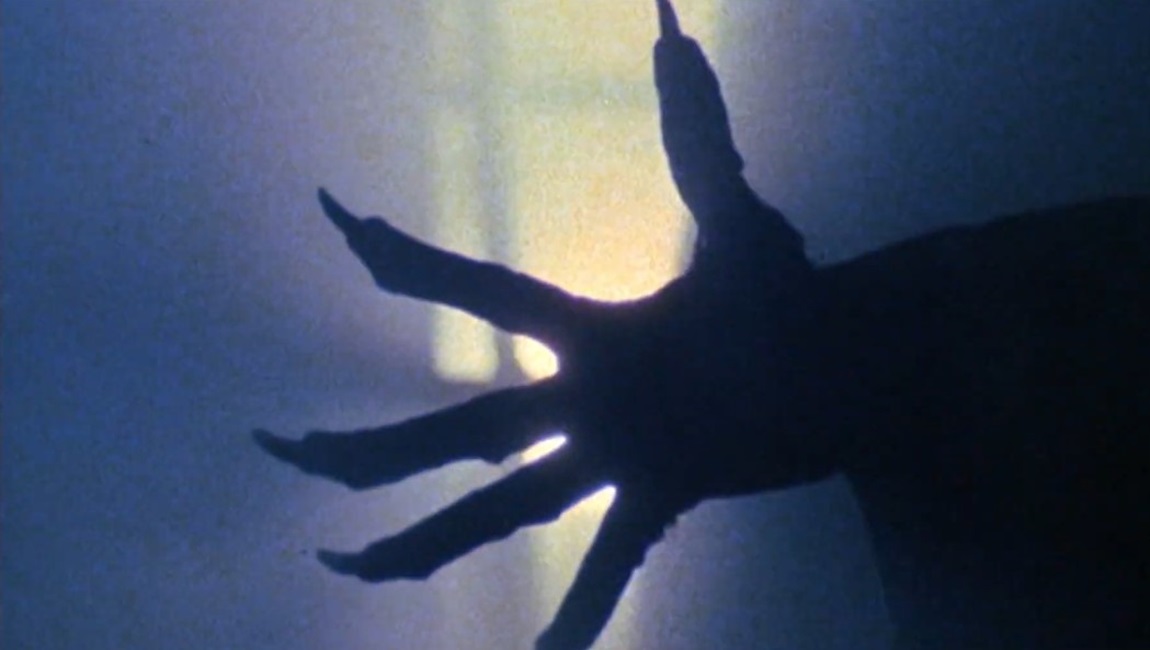
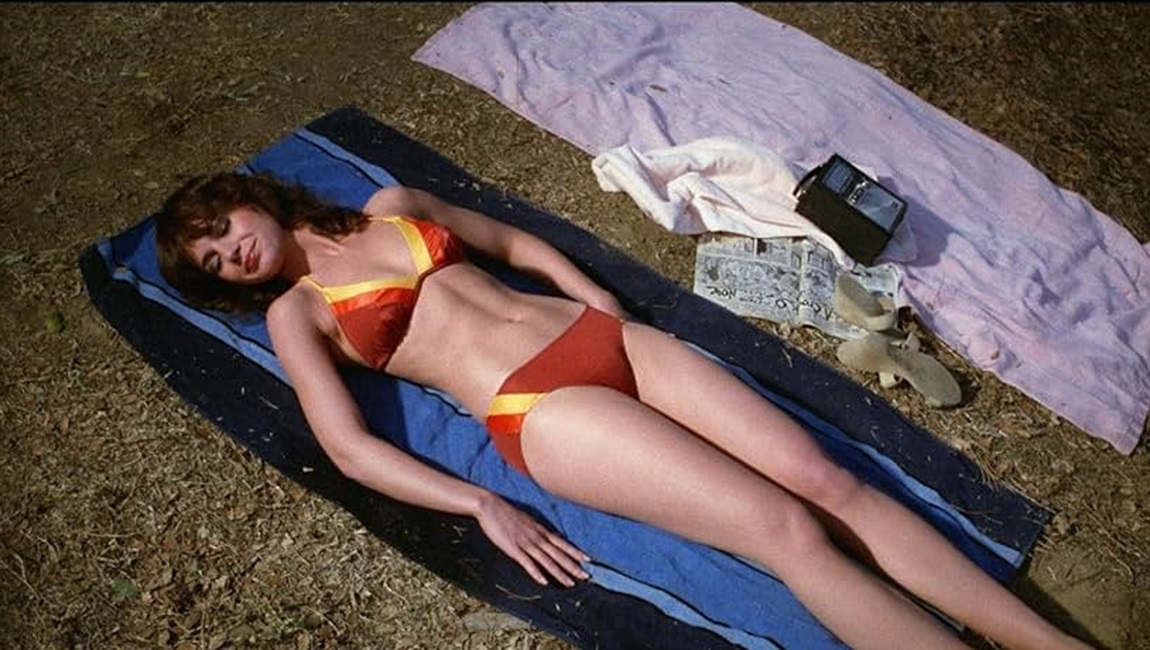
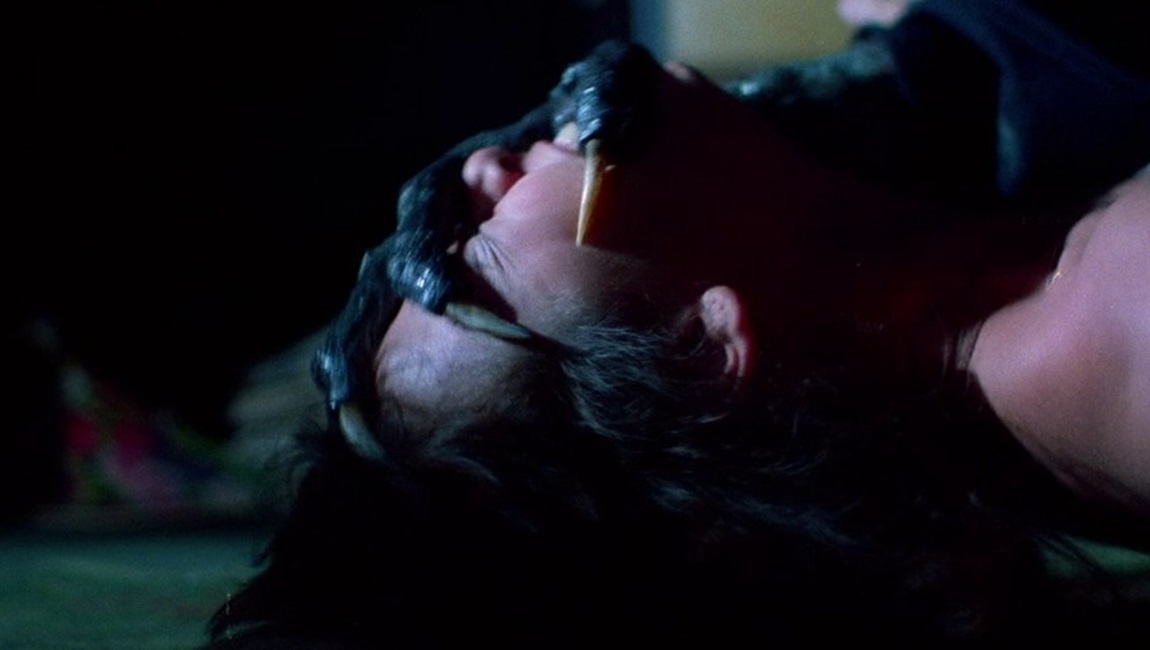
This approach continues full steam ahead. Within the next 10 minutes, viewers are both teased by the prospect of a monster dwelling on the property and treated to another wildly spectacular death scene, this time involving a circular saw blade with a mind of its own. By the time the film reaches its conclusion, Superstition has managed to amass a fairly sizable “kill count”, with none of its cast safe from the hands of fate… or the scaly hands of the mostly unseen creature. This extends to the killing of a child (albeit off-screen) as well, which naturally drew some ire from critics upon its release. Then again, horror films were under repeated attack from various “watchdogs of morality” during this era, so I’m sure that they still would have found something else to complain about had this scene been excluded. The fact that our lead priest is a bit of a pervert, happily ogling the family’s oldest daughter in her swimsuit, may or may not have been a subject of contention.
There are a few minor subplots to be found along the way, such as Leahy’s alcoholism, a mentally handicapped caretaker, and a ghostly young girl named Mary, who mysteriously appears and disappears throughout the film. However, most of these tend to be rather insignificant as there is little mystery as to what is behind all these deaths. While I do not believe that the addition of these story elements hurts the film in any real way, it would be hard for me to argue that they serve as little more than padding to the film’s runtime or as ineffective “red herrings”.
The somewhat dilapidated appearance of the property helps accentuate those eerie “haunted house” vibes that the film is clearly trying to create, especially during scenes set at night when the exterior of the house is often cast in dim blue lighting. This, and the slow “Ten Little Indians” approach to dispatching its victims (at least, until near the conclusion), help give the film an atmospheric, almost classic Gothic horror quality, while the often brutal and graphic on-screen violence and “no one is safe” mentality makes Superstition very much a product of the splatterific 1980s.
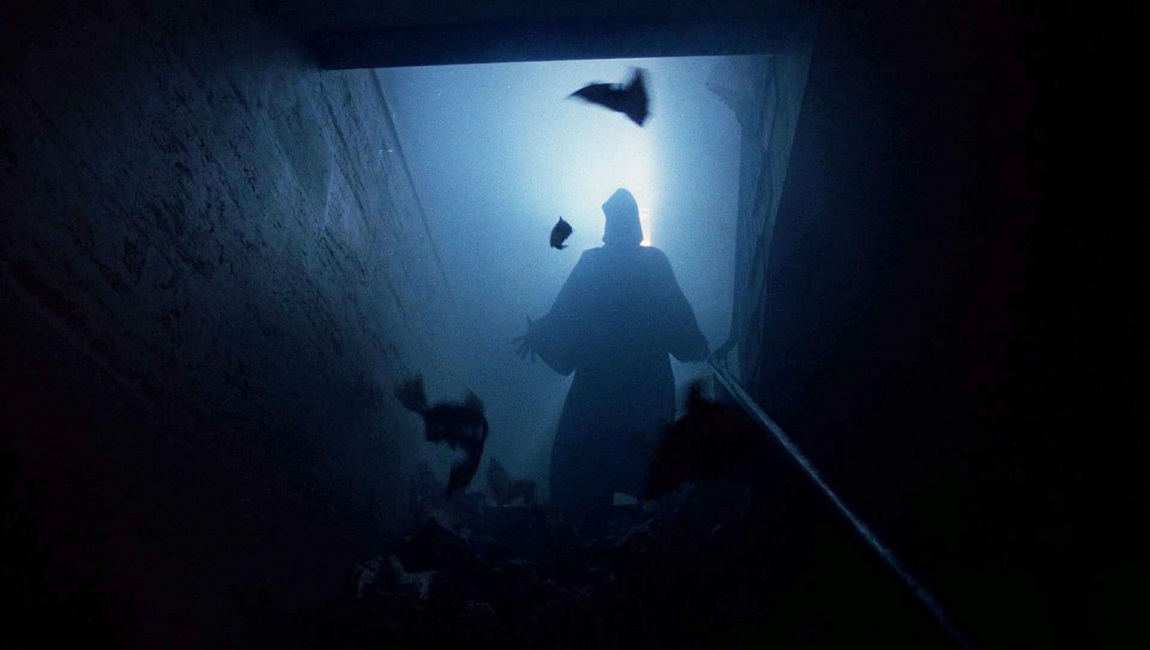
Superstition credits three different writers for its script, which implies that rewrites and revisions took place during the film’s development. This may or may not explain why certain plot points are seemingly dropped or only marginally explored. One of the film’s writers, Galen Thompson, is credited with also writing the 1978 Richard Crenna-starring “haunted house” film, The Evil, which honestly feels quite similar to this film, albeit less graphic in its violence. The film’s other writers were Michael Sajbel, who has since worked in visual effects photography on films such as Broken Arrow, Volcano, and Son In Law (yes, the Pauly Shore movie), and Bret Thompson Plate, who has no other credits to their name and may or may not actually exist.
As mentioned earlier, Superstition was not a box-office success, mostly because it was not released to theaters… not initially. The film is reported to have received release in Italy in 1982 but was otherwise shelved in the US and other markets until 1985. At that time, the film received a limited theatrical release before being shipped to home video by Lightning Video. Superstition did find itself placed on the infamous Video Nasties list in the UK at one time, but was eventually released to video uncut in 1987.
Truth be told, I’d never watched Superstition in my youth, nor do I recall ever seeing the film’s VHS cover art in all those years of scanning the shelves at numerous Mom & Pop video stores, or the corners of markets and gas stations that served as video stores. In fact, I don’t think I had ever heard of the film until I stumbled across it airing on some cable network (possibly IFC) in the late hours of the night sometime back in 2010 or so.
While I had already started surrounding myself with some rather knowledgeable horror fans at that time, I found myself disappointed that not only had none of them ever recommended this film to me, but none had even mentioned it in any of our conversations. While I readily admit that I can’t remember my thoughts from 10 years ago (much less, 10 minutes ago) I do know that I was vastly entertained by what I had watched and wanted to add a copy of the film to my ever-growing home video collection. However, although Anchor Bay had released the film to DVD in 2006, the title was now out-of-print, with used DVD copies selling for well out of my price range (i.e. cheap). I was finally able to purchase a copy of the film in 2019, when it was (finally) released to blu-ray by Scream Factory.
Although I am able find some flaws in the film, such as its generally thin characters, I still consider Superstition to be a highly enjoyable “dark ride” of a tale, one that I frequently turn to on dark, rainy nights or as the Halloween season approaches. The film’s pulpy “haunted house” aspects feel akin to something found in the pages of old EC horror comics or even DC’s “House of Mystery/Secrets” titles, while the more sadistic nature with which it gleefully dispatches with its cast of characters somewhat reminds me of Italian horror films of the era. Truth be told, the first time that I watched Superstition in my groggy state, I honestly thought it was an Italian film!
One aspect of Superstition that I do find myself highly appreciative of is the fact that the film has never received a sequel, nor is there truly a need for one. The film features a self-contained story that, while not exactly deprived of avenues for expansion, concludes in logical fashion with no real loose ends left to tie up. While the Friday the 13th franchise was somehow able to continuously lure in film viewers with the highly illogical premise of horny teens repeatedly vacationing at the site of multiple unexplained murders, I just don’t see that approach working for something like Superstition. Then again, if you kept showing up at my house unannounced and uninvited, I might be forced to kill you too. Solicitors be warned.
I wouldn’t go so far as to call Superstition one of my favorite horror films. In fact, it probably wouldn’t even crack my list of “Top 20 Horror Films of the 80s”, and may be excluded from my “Top 10 Haunted House Films” as well. That said, I do consider it to be a fantastic piece of “fluff” cinema, and one that I sadly just don’t see or hear much talk about, at least not compared to other horror films of the era, some of which I find far less deserving of praise. The “haunted house” aspects and effects aren’t quite on par with the big-budget spectacle of Spielberg’s Poltergeist, nor is the gore as extreme as something found in one of Lucio Fulci’s films. Instead, Superstition finds a niche somewhere in-between the two for those who may want something a little more intense than the terror of being attacked by a clown doll, but not quite as intense as watching Daniela Doria puke up her guts in City of the Living Dead.
As mentioned earlier, the spookier, classic horror aspects of Superstition make it a suitable fit for those dark and stormy nights or for during the Halloween season, although you never need a special occasion to turn on a good horror film. I know I don’t. Whatever the occasion, I do hope that more fans seek out Superstition if they haven’t already.
 Horror And Sons
Congrats on again stepping up to the challenge! This is one I completely missed, but your description of what it tried to do with the story and its production history makes it very intriguing (not to mention the cast)! With its supernatural elements, I can imagine that the original concept might have been a little less “splatterific” (great term by the way!) than the final product — but the money people, seeing the success of the Friday the 13th films, said “we want that!” Then, when it didn’t turn out to be exactly what they had in mind, they initially shelved it, not knowing what to do with it. Still, keeping it under wraps for several years makes no sense whatsoever.
Anyway, good to see that Superstition got at least some of the attention it deserved via the honor of being on the UK Video Nasties list, and ultimately making it to Blu-ray. A film that is a cross between an EC horror comic and an Italian horror film sounds like a must-see to me!
LikeLike